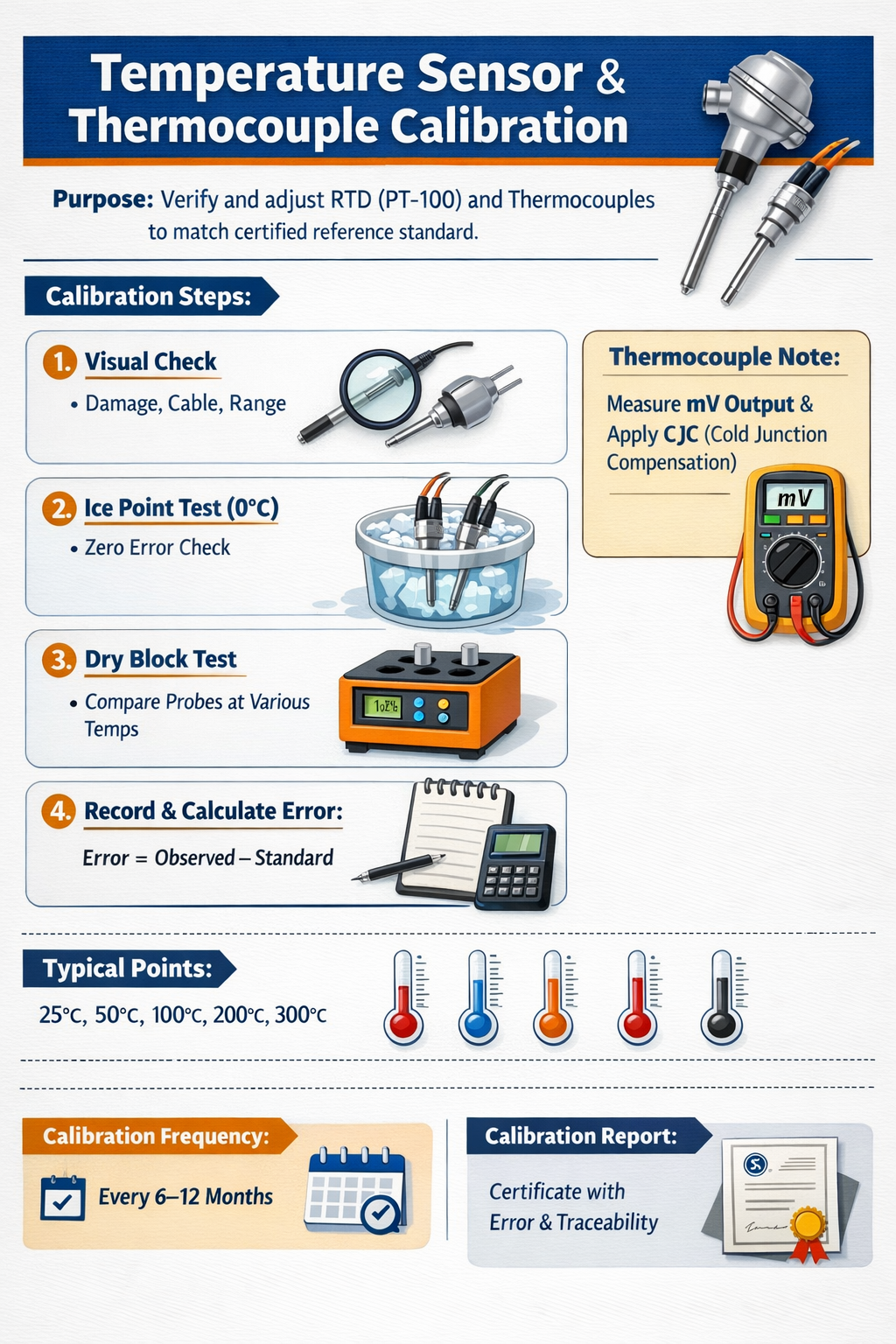
Purpose:
To verify and adjust temperature sensors (RTD/PT-100) and thermocouples so readings match a certified reference standard.

Method (Comparison):

  1. Visual Check – damage, cable, range.
  2. Ice Point Test (0°C) – check zero error using ice bath.
  3. Dry Block / Oil Bath Test – compare test probe with reference probe at multiple temperature points.
  4. Record Readings and calculate error:

Error=ObservedStandardError = Observed − StandardError=Observed−Standard

Thermocouple Note:
Measure output in mV and compare with standard thermocouple table (apply cold junction compensation).

Typical Points:
25°C, 50°C, 100°C, 200°C, 300°C (as per range)

Frequency:
6–12 months (or as per process criticality)

Output:
Calibration certificate with error, uncertainty, and traceability.
Leave a Reply

Your email address will not be published. Required fields are marked *

Explore More

What is Reference Standard in Calibration?

By ICS International Certification LLP A Reference Standard is a highly accurate and reliable measuring instrument or standard used as a benchmark for calibrating other instruments. It plays a critical

Risk-Based Calibration Interval Selection

Risk-Based Calibration Interval Selection is a method used to decide how often measuring instruments should be calibrated based on risk, instead of using a fixed time interval (like every 6

Importance of Calibration in Quality Assurance Systems

By ICS International Certification LLP In today’s competitive and quality-driven market, organizations cannot afford inaccuracies in measurement and testing processes. Calibration forms the backbone of any effective Quality Assurance (QA)