By ICS International Certification LLP
In manufacturing industries, accurate force measurement is essential for maintaining product quality, ensuring safety, and meeting regulatory requirements. Force gauges—used to measure tension, compression, pull, and push forces—play a critical role in testing and quality control processes. Regular calibration of these instruments ensures their accuracy, reliability, and compliance with international standards.
What is Force Gauge Calibration?
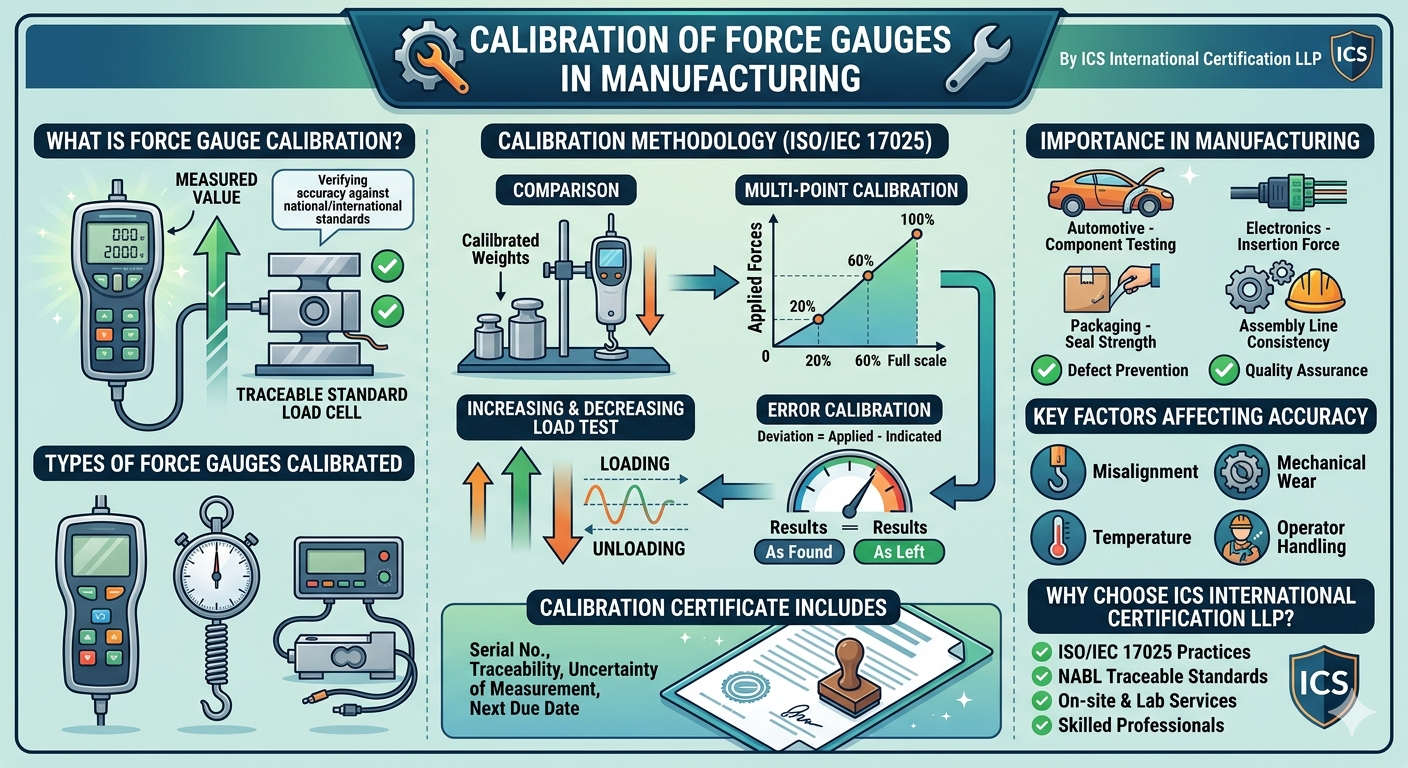
Force gauge calibration is the process of verifying and adjusting the readings of a force gauge by comparing it with traceable reference standards. This ensures that the instrument measures force accurately across its operating range.
Calibration is a key requirement under quality management systems such as ISO 9001 and ISO/IEC 17025, where measurement traceability and accuracy are mandatory.
Importance in Manufacturing
Accurate force measurement is crucial for:
- Product quality testing (e.g., tensile strength, compression resistance)
- Assembly line consistency
- Material testing and validation
- Compliance with customer and regulatory requirements
- Preventing product failures and recalls
Uncalibrated force gauges can lead to incorrect measurements, resulting in defective products and potential safety risks.
Types of Force Gauges
Calibration typically covers:
- Mechanical Force Gauges (spring-based)
- Digital Force Gauges
- Push-Pull Gauges
- Load Cells with Indicators
Calibration Methodology
At ICS International Certification LLP, force gauge calibration is performed following ISO/IEC 17025-aligned procedures:
1. Comparison with Standard Weights / Load Cells
- The force gauge is compared against calibrated standard weights or reference load cells
- Forces are applied in both tension and compression modes
2. Multi-Point Calibration
Calibration is conducted at multiple points across the range:
- Typically 0%, 20%, 40%, 60%, 80%, and 100% of full scale
3. Increasing & Decreasing Load Test
- Measurements are taken during both loading and unloading
- Helps identify hysteresis and repeatability errors
4. Error Calculation
- Deviation between applied force and indicated value is calculated
- Results recorded as As Found and As Left
Key Factors Affecting Accuracy
- Misalignment during force application
- Mechanical wear and tear
- Temperature and environmental conditions
- Operator handling errors
- Electrical drift (in digital gauges)
Calibration Certificate Includes
Calibration by ICS International Certification LLP provides:
- Instrument details (Make, Model, Serial No.)
- Calibration method and standards used
- Measurement results with deviations
- Uncertainty of measurement
- Traceability to national/international standards
- Calibration date and next due date
Applications in Manufacturing
Force gauges are widely used in:
- Packaging (seal strength testing)
- Automotive (component strength testing)
- Electronics (connector insertion/extraction force)
- Textile (fabric strength testing)
- Plastics and rubber industries
Why Choose ICS International Certification LLP?
ICS International Certification LLP offers:
- ISO/IEC 17025-based calibration practices
- NABL-traceable standards
- On-site and lab calibration services
- Skilled technical professionals
- Integrated solutions: Calibration, Inspection & Certification
Conclusion
Calibration of force gauges is vital for maintaining measurement accuracy and ensuring consistent product quality in manufacturing processes. With proper calibration and traceability, organizations can enhance reliability, reduce errors, and meet stringent quality standards.