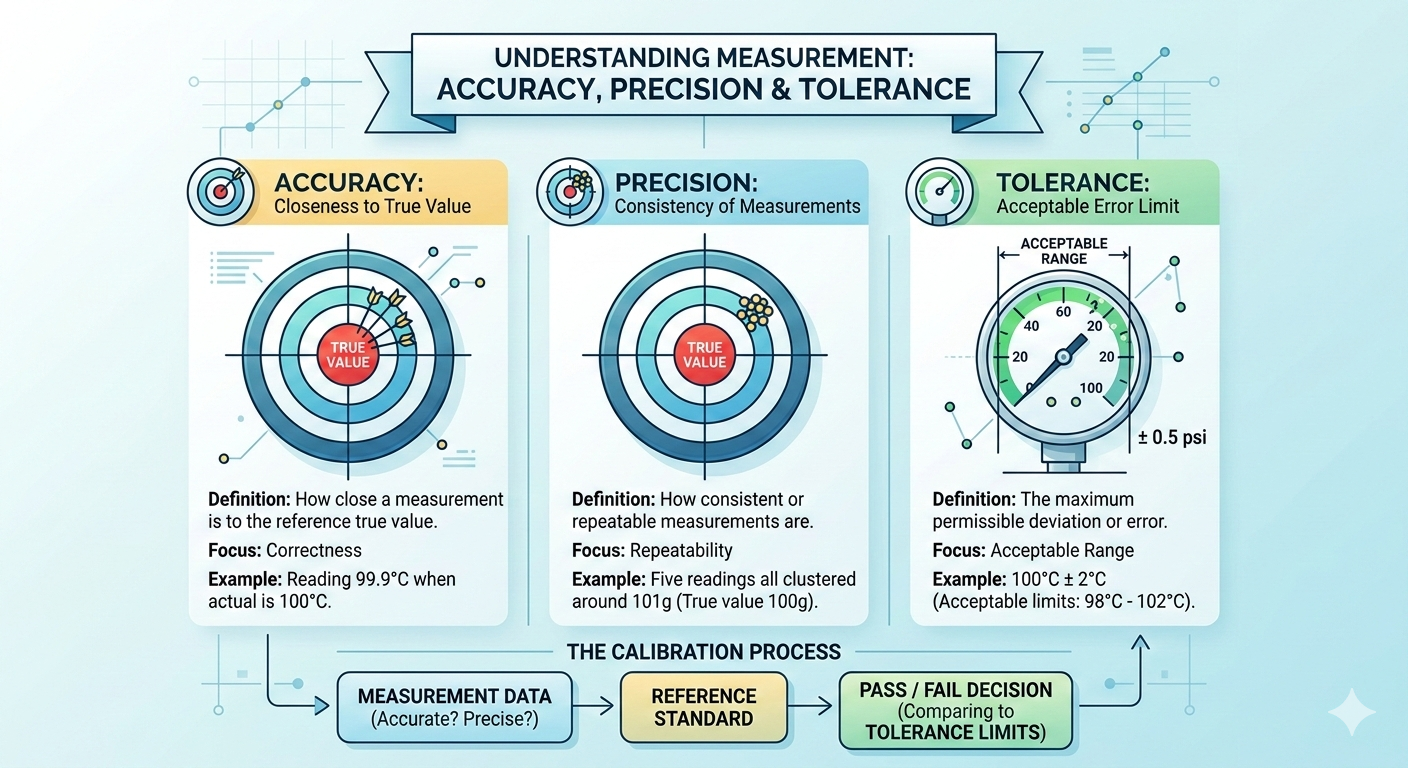
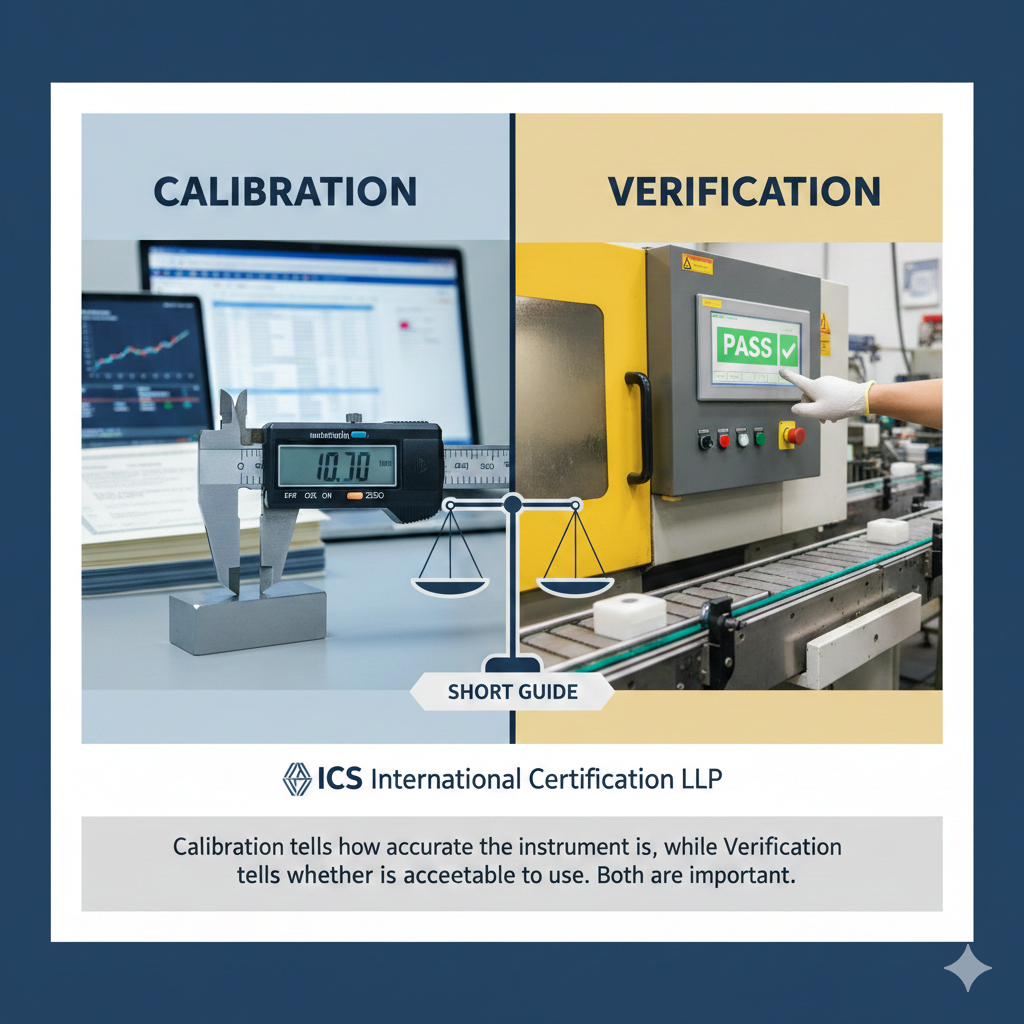
Many industries confuse Calibration and Verification, but they serve different purposes in measurement control.

Calibration is the process of comparing an instrument with a traceable standard to find its measurement error and ensure accuracy. It provides detailed results and measurement uncertainty.

Verification is checking whether the instrument meets required tolerance limits and gives a simple PASS or FAIL decision.

In simple words:
Calibration tells how accurate the instrument is, while Verification tells whether it is acceptable to use.

Both are important — calibration ensures traceability and accuracy, and verification confirms usability in production.

ICS International Certification LLP provides reliable calibration services to help maintain measurement confidence and quality compliance.
Leave a Reply

Your email address will not be published. Required fields are marked *

Explore More

Role of Calibration in ISO 9001 Certification

Calibration plays a vital role in achieving and maintaining ISO 9001 certification. As per Clause 7.1.5, organizations must ensure that all monitoring and measuring equipment is properly calibrated, traceable to

Vernier Caliper Calibration Procedure – ICS International Certification LLP

A vernier caliper is a precision instrument used to measure external, internal and depth dimensions. To ensure accurate measurement and ISO compliance, periodic calibration is required. Why Calibration is Required

Dial Gauge Calibration – Importance in Machining

By ICS INTERNATIONAL CERTIFICATION LLP In precision machining, even a small deviation can lead to rejection, rework, or customer complaints. A dial gauge (dial indicator) is widely used to measure