By ICS International Certification LLP
In modern industrial environments, accurate measurement of rotational speed is essential for ensuring equipment performance, safety, and compliance. Tachometers, widely used in rotating equipment such as motors, turbines, compressors, and pumps, must be calibrated regularly to maintain their accuracy and reliability.
📌 What is Tachometer Calibration?
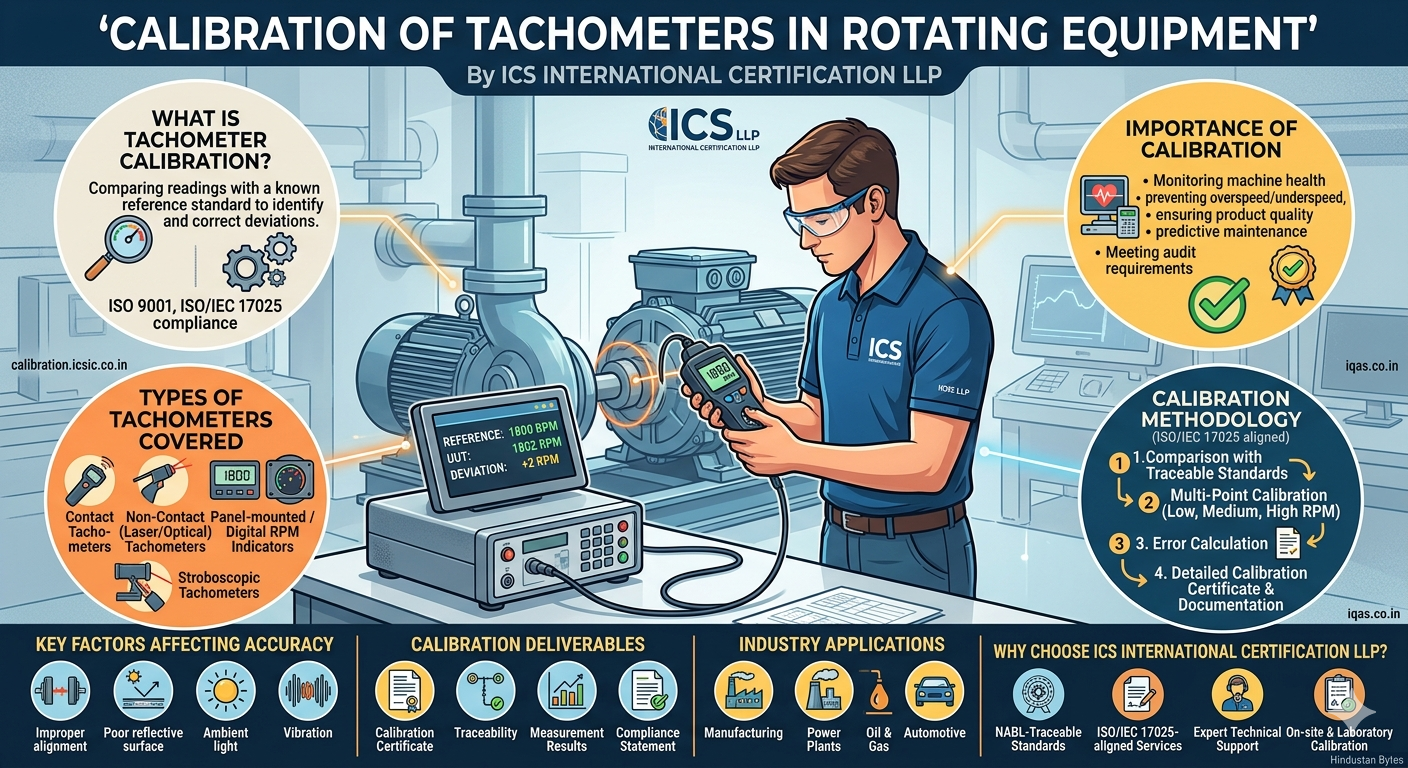
Tachometer calibration is the process of comparing the readings of a tachometer with a known reference standard to identify and correct deviations. This ensures that the instrument provides accurate RPM (revolutions per minute) readings under actual operating conditions.
Calibration is a critical requirement under quality standards such as ISO 9001 and ISO/IEC 17025, where measurement accuracy and traceability are mandatory. (calibration.icsic.co.in)
🎯 Importance of Calibration in Rotating Equipment
Accurate tachometer readings are vital for:
- Monitoring machine health and performance
- Preventing overspeed or underspeed conditions
- Ensuring product quality in manufacturing
- Supporting predictive maintenance programs
- Meeting audit and compliance requirements
Without proper calibration, measurement results cannot be considered reliable or traceable to international standards. (calibration.icsic.co.in)
⚙️ Types of Tachometers Covered
Calibration services typically include:
- Contact Tachometers – Direct contact with rotating shaft
- Non-Contact (Laser/Optical) Tachometers – Use reflective targets
- Panel-mounted / Digital RPM Indicators
- Stroboscopic Tachometers
🧪 Calibration Methodology
At ICS International Certification LLP, tachometer calibration is performed using standardized procedures aligned with ISO/IEC 17025:
1. Comparison Method
- The tachometer under test is compared with a calibrated reference tachometer or RPM source
- Readings are taken at multiple speed points
2. Use of Traceable Standards
- Reference instruments are calibrated and traceable to national/international standards
- Ensures measurement credibility and audit acceptance
3. Multi-Point Calibration
Typical calibration points include:
- Low speed (e.g., 100–500 RPM)
- Medium speed (e.g., 1000–2000 RPM)
- High speed (e.g., up to 5000 RPM or more)
4. Error Calculation
- Deviation is calculated between observed and reference values
- Results are recorded as “As Found” and “As Left” data
This comparison-based approach is widely used in accredited calibration systems for tachometers. (iqas.co.in)
🔍 Key Factors Affecting Accuracy
- Improper alignment (contact type)
- Poor reflective surface (non-contact type)
- Ambient light interference
- Vibration and environmental conditions
- Electrical noise in digital systems
📊 Calibration Deliverables
Each calibration performed by ICS International Certification LLP includes:
- Calibration Certificate with traceability
- Measurement results and deviations
- Uncertainty of measurement
- Environmental conditions
- Compliance statement as per ISO standards
Proper documentation ensures audit readiness and compliance with global quality systems.
🏭 Industry Applications
Tachometer calibration is essential across industries such as:
- Manufacturing and automation
- Power plants and energy sector
- Oil & gas and petrochemicals
- Automotive and engineering
- HVAC and rotating machinery systems
✅ Why Choose ICS International Certification LLP?
ICS International Certification LLP provides:
- ISO/IEC 17025-aligned calibration services
- NABL-traceable measurement standards
- On-site and laboratory calibration support
- Experienced technical experts
- End-to-end compliance solutions (Calibration + Certification + Inspection) (Hindustan Bytes)
📌 Conclusion
Calibration of tachometers is not just a technical requirement—it is a fundamental part of ensuring operational accuracy, safety, and compliance. By maintaining traceable and precise measurements, organizations can enhance equipment reliability, reduce downtime, and confidently meet international quality standards.