In calibration, testing, and quality management systems such as ISO/IEC 17025, understanding the difference between measurement error and measurement uncertainty is essential. These two concepts are closely related but represent different aspects of measurement reliability.
What is Measurement Error?
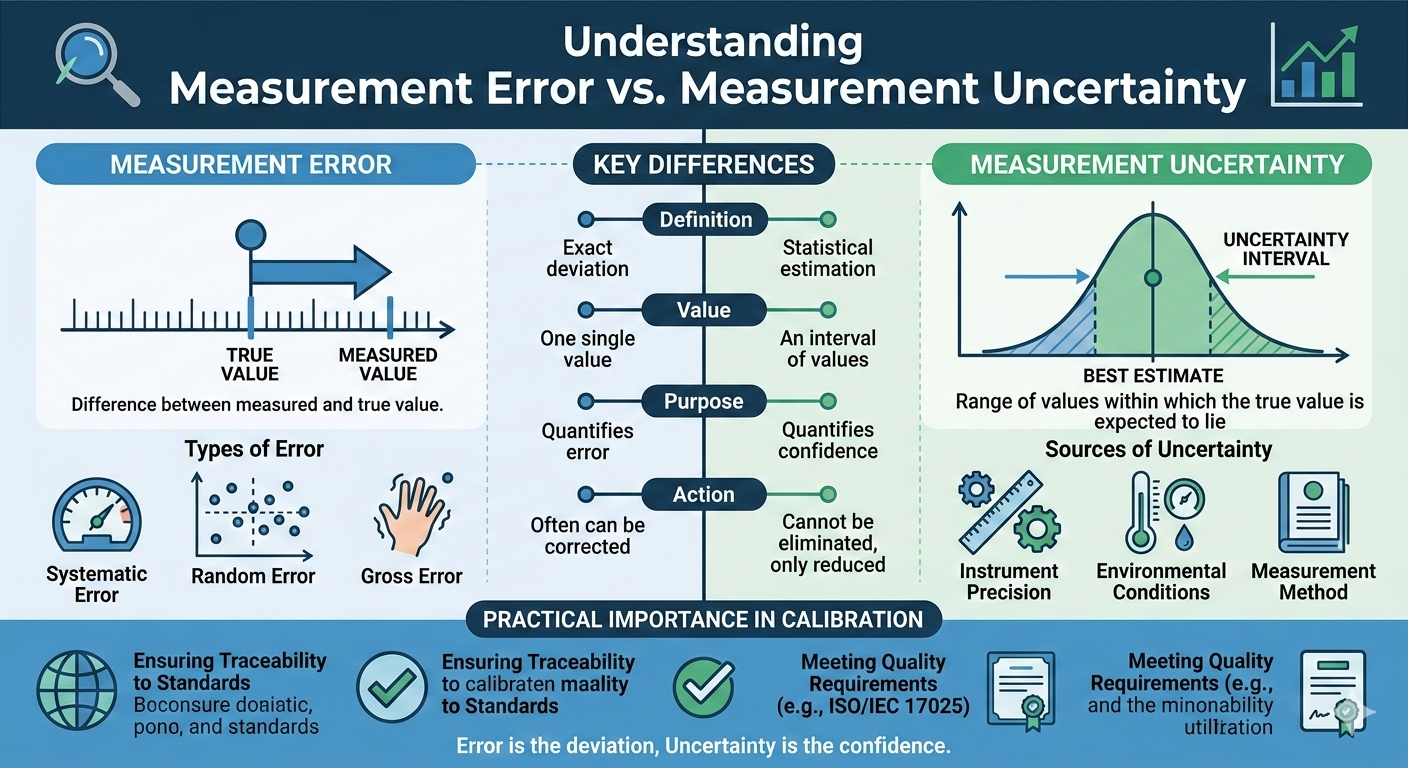
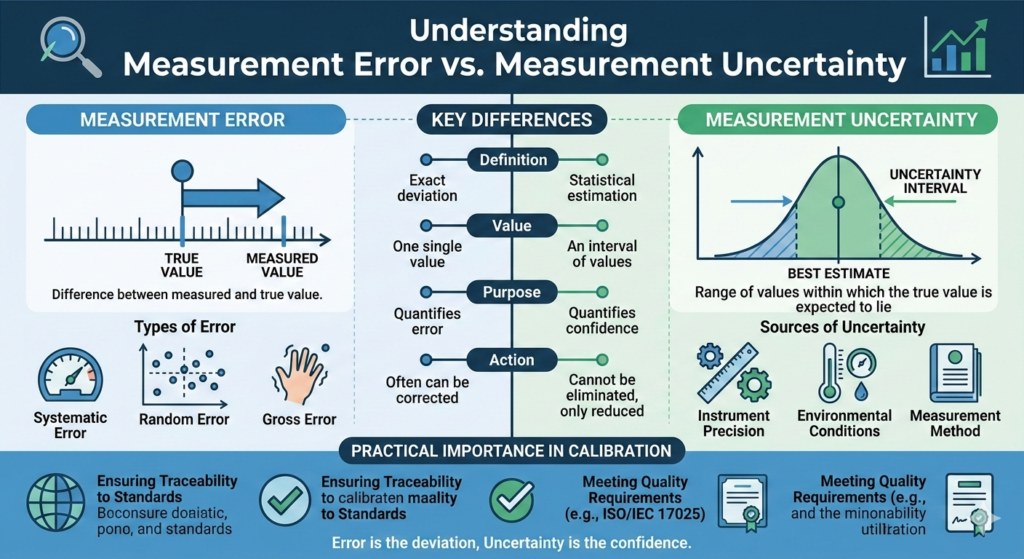
Measurement error is the difference between the measured value and the true (reference) value of a quantity. Error=Measured Value−True Value
Example
If the true weight of an object is 50 g but the instrument reads 50.000112 g, the difference (0.000112 g) represents the measurement error.
Types of Measurement Error
Common categories include:
- Systematic Error
- Consistent and predictable error.
- Often caused by improper calibration or instrument bias.
- Random Error
- Caused by unpredictable variations such as environmental conditions or operator handling.
- Gross Error
- Human mistakes like reading instruments incorrectly.
In many calibration processes, known errors can often be corrected using correction factors obtained from calibration results.
What is Measurement Uncertainty?
Measurement uncertainty describes the range of values within which the true value is expected to lie, considering all possible sources of variation.
It represents the degree of confidence in a measurement result.
Example:100.0±0.5mm
This means the true value is expected to lie between 99.5 mm and 100.5 mm with a specified confidence level.
Measurement uncertainty arises from several factors, including:
- Instrument precision
- Environmental conditions (temperature, humidity)
- Measurement method
- Operator skill
- Calibration standards
Because no measurement is perfect, every measurement contains some level of uncertainty.
Key Differences Between Error and Uncertainty
| Aspect | Measurement Error | Measurement Uncertainty |
|---|---|---|
| Definition | Difference between measured and true value | Estimated range around the measurement |
| Nature | Exact deviation | Statistical estimation |
| Correction | Often can be corrected | Cannot be eliminated, only reduced |
| Purpose | Shows deviation | Shows confidence in the measurement |
Experts emphasize that uncertainty is not the error itself; it simply represents the limit of our knowledge about the measurement result.
Practical Importance in Calibration
In calibration laboratories and quality management systems:
- Error helps determine how far a measurement deviates from the standard.
- Uncertainty indicates how reliable the measurement result is.
Standards such as ISO/IEC 17025 require laboratories to estimate and report measurement uncertainty to ensure reliable and comparable results across different laboratories.