By ICS International Certification LLP
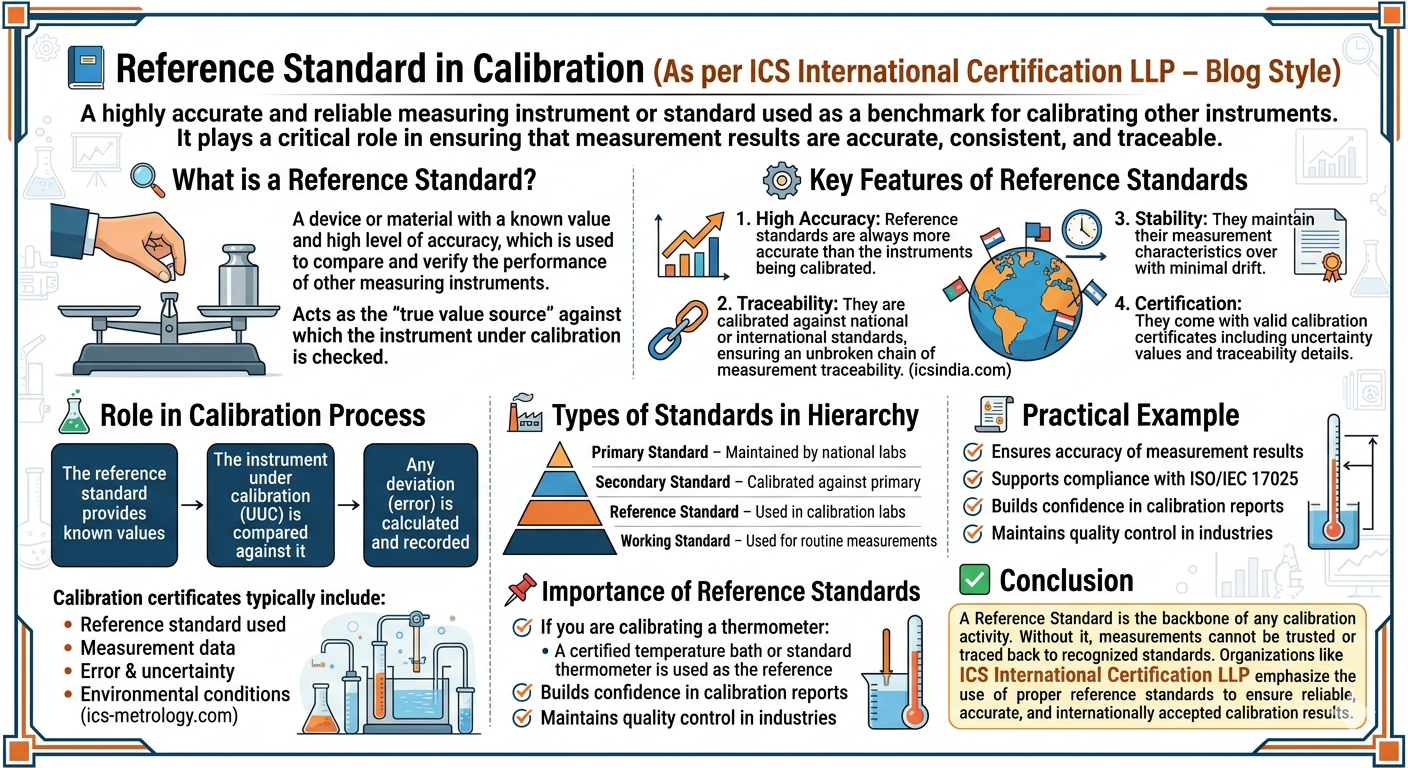
A Reference Standard is a highly accurate and reliable measuring instrument or standard used as a benchmark for calibrating other instruments. It plays a critical role in ensuring that measurement results are accurate, consistent, and traceable.
🔍 What is a Reference Standard?
A reference standard is a device or material with a known value and high level of accuracy, which is used to compare and verify the performance of other measuring instruments.
In calibration practice, it acts as the “true value source” against which the instrument under calibration is checked.
⚙️ Key Features of Reference Standards
1. High Accuracy
Reference standards are always more accurate than the instruments being calibrated.
2. Traceability
They are calibrated against national or international standards, ensuring an unbroken chain of measurement traceability. (icsindia.com)
3. Stability
They maintain their measurement characteristics over time with minimal drift.
4. Certification
They come with valid calibration certificates including uncertainty values and traceability details.
🧪 Role in Calibration Process
During calibration:
- The reference standard provides known values
- The instrument under calibration (UUC) is compared against it
- Any deviation (error) is calculated and recorded
Calibration certificates typically include:
- Reference standard used
- Measurement data
- Error & uncertainty
- Environmental conditions (ics-metrology.com)
🏭 Types of Standards in Hierarchy
ICS-based understanding generally follows this hierarchy:
- Primary Standard – Maintained by national labs
- Secondary Standard – Calibrated against primary
- Reference Standard – Used in calibration labs
- Working Standard – Used for routine measurements
📌 Importance of Reference Standards
- Ensures accuracy of measurement results
- Supports compliance with ISO/IEC 17025
- Builds confidence in calibration reports
- Maintains quality control in industries
🧾 Practical Example
If you are calibrating a thermometer:
- A certified temperature bath or standard thermometer is used as the reference
- The test thermometer readings are compared
- Differences are recorded and corrected
✅ Conclusion
A Reference Standard is the backbone of any calibration activity. Without it, measurements cannot be trusted or traced back to recognized standards. Organizations like ICS International Certification LLP emphasize the use of proper reference standards to ensure reliable, accurate, and internationally accepted calibration results.