Below is a detailed explanation of the Guard Banding Concept in Calibration Decisions, based on the metrology principles discussed in calibration resources and aligned with the type of technical explanations typically published on the calibration blog of ICS International Certification LLP.
Guard Banding Concept in Calibration Decisions
- Introduction
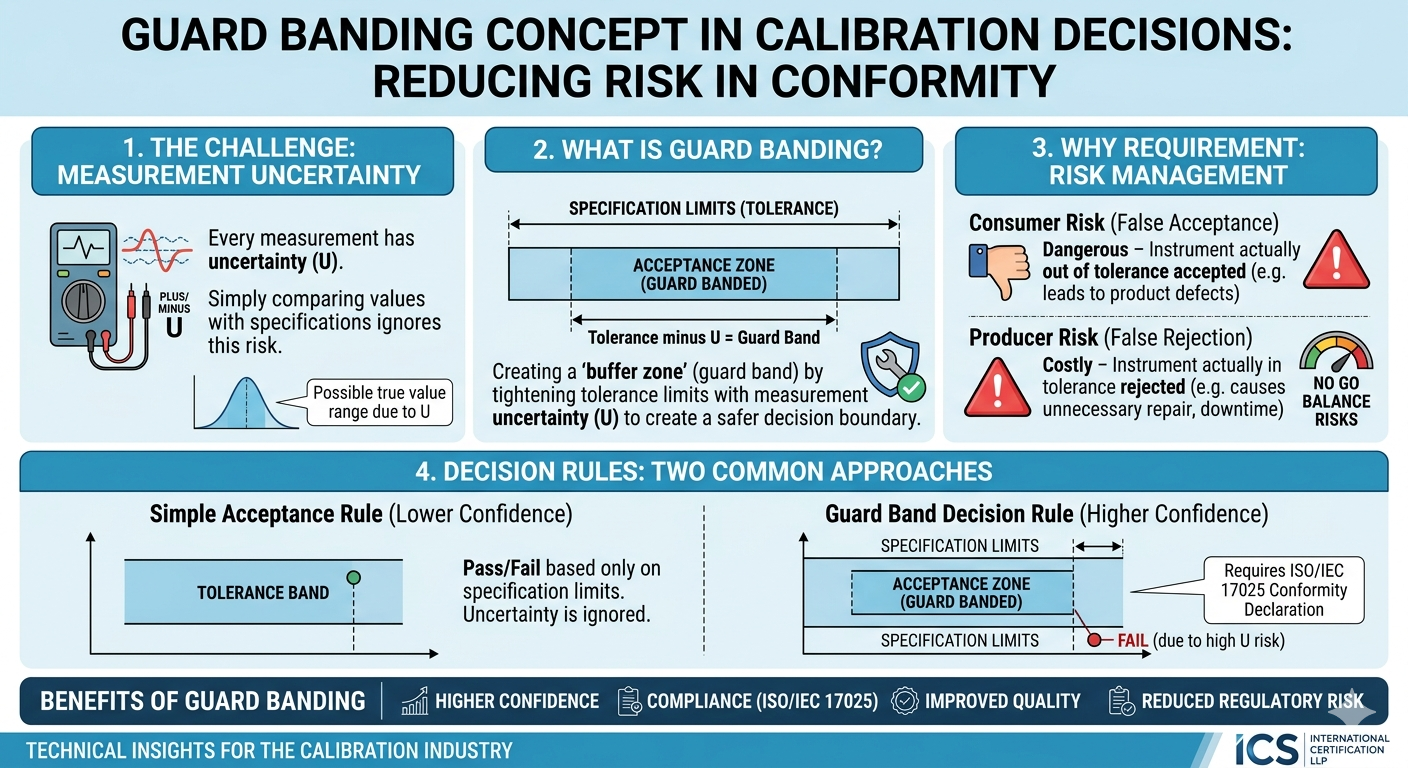
In calibration, laboratories determine whether a measuring instrument meets or fails specified tolerance limits. However, every measurement contains some measurement uncertainty due to environmental conditions, equipment limitations, operator influence, and calibration standards.
Because of this uncertainty, simply comparing a measurement value with specification limits may lead to incorrect pass or fail decisions. Guard banding is a statistical technique used to reduce the risk of wrong conformity decisions.
- What is Guard Banding?
Guard banding is a method where the acceptance limits are tightened by subtracting measurement uncertainty from the specification limits to create a safer decision boundary.
Instead of accepting results exactly at tolerance limits, a buffer zone (guard band) is created to ensure higher confidence that the instrument actually meets specifications.
Basic idea
Specification limit = tolerance provided by manufacturer or standard
Guard band limit = specification limit minus measurement uncertainty
This creates a narrower acceptance zone for pass decisions.
If the measured value falls within this smaller zone, the instrument is considered compliant with higher confidence.
- Why Guard Banding is Required
Guard banding is applied mainly to control decision risks in calibration.
- Consumer Risk (False Acceptance)
A device that is actually out of tolerance may be incorrectly accepted as pass.
Example:
A pressure gauge may appear within tolerance due to measurement uncertainty.
If accepted wrongly, it may produce incorrect measurements in production.
This risk is dangerous because it can lead to:
product defects
safety failures
regulatory non-compliance.
- Producer Risk (False Rejection)
A device that is actually within tolerance may be rejected.
This causes:
unnecessary repair or recalibration
downtime
increased operational cost.
Guard banding balances these two risks.
- Relationship Between Guard Banding and Measurement Uncertainty
Measurement uncertainty is the foundation of guard banding.
The uncertainty value determines how wide the guard band should be.
Example:
Specification tolerance
±100 µV
Measurement uncertainty
±8 µV
Guard band acceptance limit
±(100 − 8) = ±92 µV
If measured value = +90 µV → PASS
If measured value = +98 µV → FAIL
Although +98 µV is inside the tolerance limit, the uncertainty makes compliance uncertain.
- Decision Rules in Calibration
According to ISO/IEC 17025, when a laboratory declares conformity (pass/fail), it must apply a decision rule that explains how measurement uncertainty is considered.
Two common decision rules:
- Simple Acceptance Rule
Pass or fail based only on tolerance limits.
Example
Tolerance = ±5 units
Measured value = +4.9 → PASS
Measurement uncertainty is ignored.
- Guard Band Decision Rule
Pass or fail considering measurement uncertainty.
Example
Tolerance = ±5 units
Uncertainty = ±1 unit
Guard band limit = ±4 units
Measured value = +4.5 → FAIL
Because uncertainty could push the true value outside tolerance.
- How Guard Bands Are Applied
Guard bands are applied differently depending on the situation.
Symmetrical Guard Band
Used when limits exist on both sides.
Example
Tolerance = ±10
Acceptance zone
= ±(10 − U)
Single-Sided Guard Band
Used when there is only one limit.
Example
Maximum temperature limit = 100°C
Guard band limit
= 100 − U
- Guard Banding and Test Uncertainty Ratio (TUR)
A common guideline in calibration is the Test Uncertainty Ratio (TUR).
TUR = Tolerance / Measurement Uncertainty
Typical requirement:
TUR ≥ 4:1
If TUR is lower, guard banding is applied to reduce the probability of false acceptance.
- Benefits of Guard Banding
Guard banding provides several advantages in calibration:
- Higher confidence in conformity decisions
Reduces risk of approving non-conforming instruments.
- Compliance with ISO/IEC 17025
Laboratories must define decision rules when issuing conformity statements.
- Improved product quality
Ensures measurement devices used in manufacturing are reliable.
- Reduced regulatory risk
Prevents failures during audits or certification assessments.
- Practical Example in Calibration
Suppose a digital multimeter is calibrated.
Manufacturer tolerance
±1.00 V
Measurement uncertainty
±0.15 V
Guard band limit
±(1 − 0.15) = ±0.85 V
Measured deviation = +0.90 V
Result:
Within tolerance → Yes
Within guard band → No
Therefore the instrument is considered not conforming under guard band decision rule.
- Importance for Industry
Guard banding is critical in industries such as:
aerospace
automotive
pharmaceuticals
medical devices
energy sector
Because incorrect calibration decisions can lead to product failures, safety hazards, and financial loss.
✔ Summary
Guard banding is a calibration decision technique used to account for measurement uncertainty by tightening tolerance limits. It reduces the risk of false acceptance and ensures more reliable pass/fail decisions in accordance with ISO/IEC 17025 decision rules.