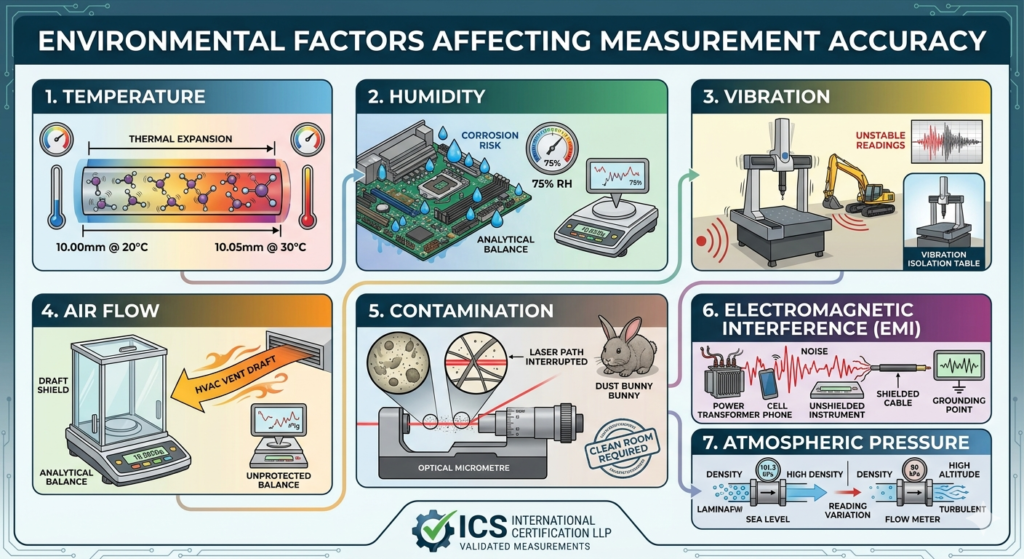
In industries that rely on precise measurements—such as manufacturing, calibration laboratories, pharmaceuticals, and quality control—measurement accuracy is critical. Even highly advanced measuring instruments can produce incorrect results if environmental conditions are not properly controlled.
Environmental factors influence both the measuring equipment and the object being measured. Understanding and controlling these factors is essential for ensuring reliable, repeatable, and traceable measurement results.
This article explains the key environmental conditions that affect measurement accuracy and the best practices to control them.
1. Temperature
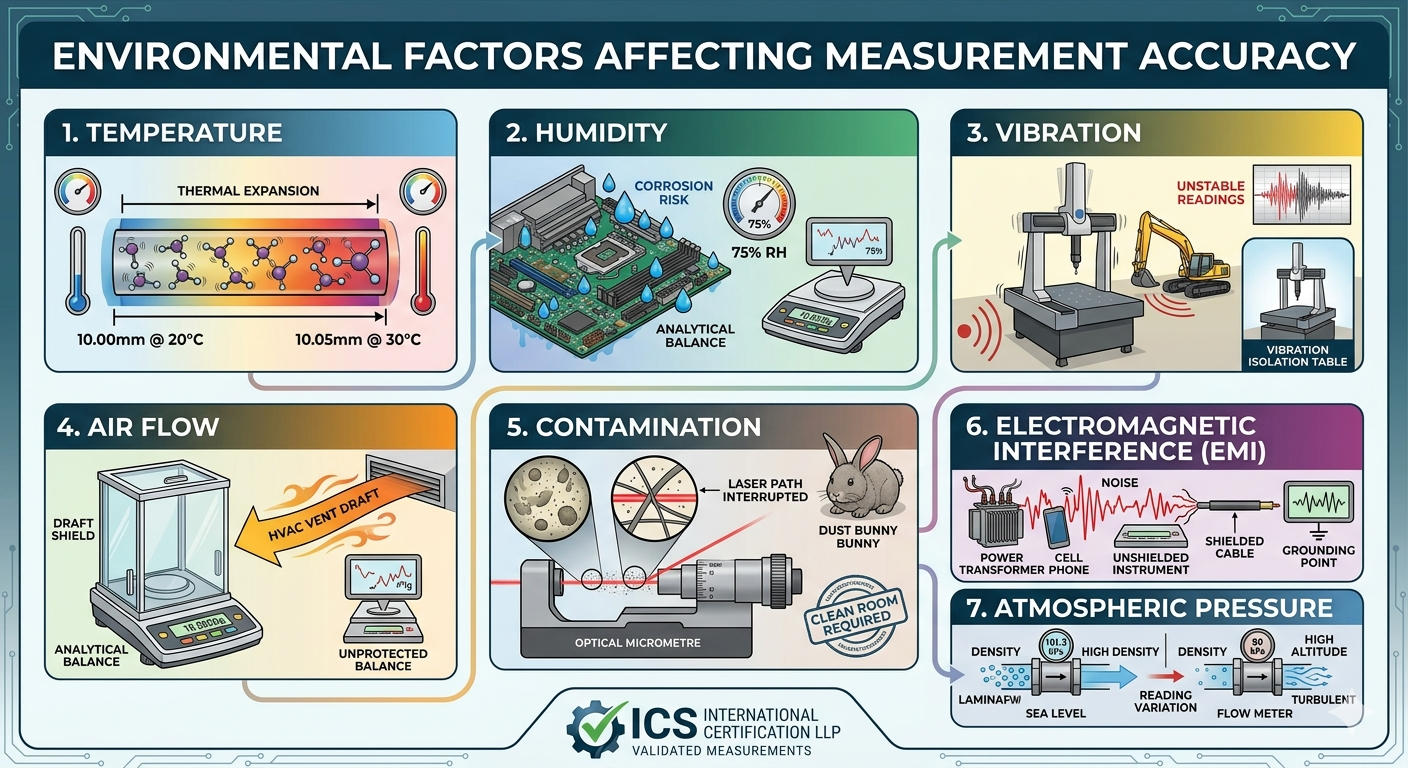
Temperature is one of the most significant environmental factors influencing measurement accuracy. Changes in temperature can cause materials and measuring instruments to expand or contract, leading to dimensional errors.
For example:
- Metal components expand when heated and contract when cooled.
- Precision instruments may drift from their calibrated values if the temperature changes significantly.
Even small temperature variations can introduce measurement deviations. Therefore, most metrology laboratories maintain a controlled environment around 20°C, which is considered the international reference temperature for precision measurement.
Best Practices
- Maintain stable laboratory temperature.
- Allow instruments and test samples to reach thermal equilibrium before measurement.
- Avoid placing measuring equipment near heat sources or direct sunlight.
2. Humidity
Humidity refers to the amount of moisture present in the air. High humidity can affect measurement accuracy in several ways:
- Moisture may condense on instrument surfaces.
- Electronic components can corrode or malfunction.
- Measurement surfaces may become contaminated.
Humidity can also affect air density and influence sensitive instruments such as analytical balances or optical measurement systems.
Best Practices
- Maintain relative humidity typically between 40% and 60% in measurement environments.
- Use dehumidifiers or climate-control systems when necessary.
- Protect instruments from condensation and moisture exposure.
3. Vibration and Mechanical Disturbances
Vibrations from nearby machinery, vehicles, or foot traffic can significantly affect measurement stability. Precision instruments like balances, coordinate measuring machines (CMM), and laser measurement systems are particularly sensitive to vibrations.
Even small vibrations can cause fluctuations in readings or prevent instruments from stabilizing.
Best Practices
- Install measuring instruments on vibration-isolated tables.
- Locate measurement laboratories away from heavy machinery.
- Use vibration damping systems when necessary.
4. Air Flow and Air Currents
Air movement caused by HVAC systems, open doors, or personnel movement can create disturbances during measurements. In high-precision weighing or dimensional measurements, air currents can produce unstable readings.
For example:
- Drafts can apply small forces on weighing pans.
- Airflow can change temperature distribution around instruments.
Best Practices
- Use draft shields for sensitive instruments.
- Position equipment away from air vents and windows.
- Maintain stable airflow conditions within the measurement area.
5. Dust, Contamination, and Air Quality
Dust particles, debris, and contaminants can accumulate on measurement surfaces or instrument sensors, leading to inaccurate results. These particles may interfere with mechanical movement or optical measurement systems.
Best Practices
- Maintain clean laboratory environments.
- Implement proper housekeeping procedures.
- Use filtered air systems where required.
6. Electromagnetic Interference (EMI)
Electromagnetic interference from nearby electrical equipment, power lines, or communication devices can affect sensitive electronic instruments. This interference may distort signals and cause measurement errors.
Best Practices
- Properly ground measuring instruments.
- Avoid placing sensitive equipment near strong electromagnetic sources.
- Use shielded cables and equipment when necessary.
7. Atmospheric Pressure
Changes in atmospheric pressure can influence instruments that rely on pressure or density measurements, such as flow meters or pressure sensors. Pressure variations may alter the physical properties of gases and liquids, affecting measurement results.
Best Practices
- Apply pressure corrections when required.
- Use instruments designed for specific environmental conditions.
Importance of Environmental Control in Calibration and Testing
Controlling environmental conditions is essential for maintaining measurement reliability and ensuring compliance with international standards such as ISO/IEC 17025 and other quality management systems.
Stable environmental conditions help achieve:
- Consistent measurement results
- Improved repeatability and reproducibility
- Reduced measurement uncertainty
- Compliance with international quality standards
Organizations involved in calibration, inspection, and testing must implement strict environmental monitoring procedures to maintain measurement accuracy.