🏆 Celebrating Quality Excellence: Building a Culture of Quality in Industry
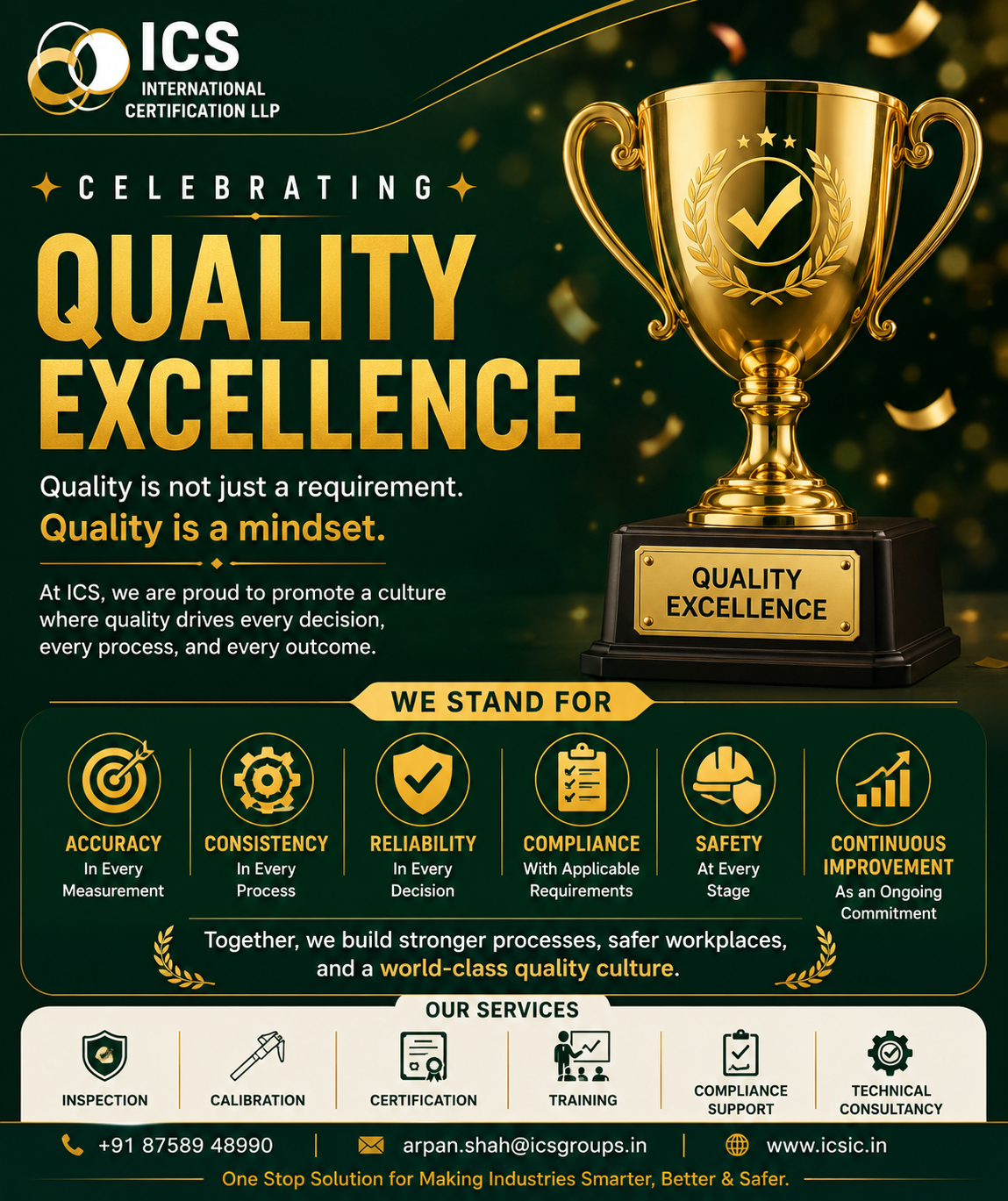
Quality excellence is more than achieving a target, passing an inspection, or obtaining a certification. True quality excellence is a continuous commitment to accuracy, consistency, reliability, compliance, safety, and improvement.
For modern industries, quality is no longer only the responsibility of the quality department. It is a shared responsibility across management, engineering, production, inspection, maintenance, purchasing, and every person involved in the process.
At ICS International Certification LLP, we believe that:
Quality is not just a requirement. Quality is a mindset.
This blog explores what quality excellence means and how organizations can build a stronger quality culture.
What Is Quality Excellence?
Quality excellence is the ability of an organization to consistently deliver products, services, and processes that meet applicable requirements while continuously improving performance.
It involves more than checking the final product.
A quality-focused organization considers quality throughout the complete process:
Planning → Design → Procurement → Manufacturing → Inspection → Testing → Delivery → Customer Feedback → Improvement
The objective is to prevent problems rather than simply detect them after they occur.
1. Accuracy in Every Measurement
Reliable measurement is fundamental to quality.
Manufacturing and inspection decisions often depend on measurements taken using instruments such as:
- Vernier calipers
- Micrometers
- Pressure gauges
- Dial indicators
- Height gauges
- Temperature instruments
- Weighing equipment
- Electrical measuring instruments
If measurements are unreliable, quality decisions can also become unreliable.
That is why organizations should establish appropriate controls for measuring and testing equipment, including calibration or verification where applicable.
The principle is simple:
Reliable measurement supports reliable decisions.
2. Consistency in Every Process
Quality excellence requires consistency.
A process that produces acceptable results occasionally—but not consistently—is difficult to control.
Organizations should establish appropriate:
- Procedures
- Work instructions
- Inspection plans
- Process controls
- Competency requirements
- Monitoring methods
- Acceptance criteria
Consistency helps reduce variation and makes it easier to identify abnormal conditions.
3. Reliability in Every Decision
Quality professionals make decisions based on information.
These decisions may involve:
- Accepting or rejecting components
- Approving inspection results
- Evaluating measurements
- Selecting suppliers
- Reviewing test results
- Releasing products
- Investigating nonconformities
Reliable decisions require reliable information.
This is why documentation, traceability, measurement control, inspection competence, and objective evidence are so important.
4. Compliance With Applicable Requirements
Quality excellence also means understanding and meeting applicable requirements.
Depending on the organization and industry, requirements may come from:
- Customer specifications
- Engineering drawings
- Purchase orders
- Contracts
- Applicable standards
- Regulatory requirements
- Internal procedures
- Inspection & Test Plans
- Product specifications
Compliance should not be treated simply as paperwork.
It should be integrated into the organization’s actual processes.
5. Safety at Every Stage
Quality and safety are closely connected.
A quality failure can sometimes become a safety issue, particularly in industries involving:
- Pressure equipment
- Heavy machinery
- Structural components
- Automotive parts
- Electrical systems
- Chemical processes
- Critical industrial equipment
Strong quality controls can help reduce the risk of defects reaching applications where failure could have serious consequences.
Quality is therefore not only about appearance or performance.
Quality can also contribute to safer operations.
6. Continuous Improvement
Quality excellence is not a one-time achievement.
Organizations should continually ask:
What can we improve?
Continuous improvement can involve:
- Reducing defects
- Improving inspection processes
- Reducing rework
- Improving measurement systems
- Increasing process efficiency
- Improving employee competency
- Strengthening supplier controls
- Improving documentation
- Learning from customer feedback
Even small improvements can create significant long-term benefits when they are implemented consistently.
Quality Is Everyone’s Responsibility
One of the biggest barriers to quality excellence is believing that:
“Quality is only the Quality Department’s responsibility.”
In reality, quality is influenced by almost every function.
Management
Provides leadership, resources, objectives, and direction.
Engineering
Develops designs, specifications, and technical requirements.
Procurement
Controls purchased materials, products, and suppliers.
Production
Controls manufacturing processes and workmanship.
Inspection
Verifies specified requirements.
Maintenance
Maintains equipment and process reliability.
Employees
Follow procedures, identify problems, and contribute to improvement.
When everyone understands their role, quality becomes part of the organizational culture.
The Importance of Inspection
Inspection provides valuable information about whether specified requirements have been met.
Depending on the application, inspection may include:
🔍 Visual Inspection
📏 Dimensional Inspection
⚙️ Machining Inspection
🔥 Welding Inspection
🏭 Fabrication Inspection
🔩 Casting Inspection
🔨 Forging Inspection
🧪 Testing
🔬 NDT
📋 Documentation Review
However, inspection should be viewed as one part of a broader quality system.
Inspection detects and verifies. Process control helps prevent.
Both are important.
The Role of Calibration in Quality Excellence
Measurement equipment is an important part of many quality-control systems.
Consider a component with a specified dimensional tolerance.
If the measuring instrument is not suitable or its performance is not adequately controlled, the organization may make an incorrect decision.
Possible consequences include:
❌ Accepting defective components
❌ Rejecting acceptable components
❌ Unnecessary rework
❌ Process adjustments
❌ Customer complaints
❌ Production losses
Effective calibration and measurement management help organizations maintain confidence in their measurement results.
Third-Party Inspection and Quality Confidence
Independent third-party inspection can provide additional verification against agreed requirements.
Depending on the scope, third-party inspection may include:
- Material inspection
- Casting inspection
- Forging inspection
- Fabrication inspection
- Welding inspection
- Dimensional inspection
- NDT review
- Testing
- Final inspection
- Pre-dispatch inspection
- Documentation review
The inspection scope should always be defined by the applicable contractual and technical requirements.
Quality Excellence Is More Than “Zero Defects”
Zero defects is an attractive objective, but quality excellence is broader than simply counting defects.
A strong quality culture also focuses on:
✅ Prevention
✅ Risk awareness
✅ Process consistency
✅ Reliable measurements
✅ Competent personnel
✅ Customer requirements
✅ Compliance
✅ Safety
✅ Continuous improvement
The goal is to build processes that consistently produce the required results.
Common Barriers to Quality Excellence
Organizations may face several challenges when developing a quality culture.
❌ Reactive Quality Management
Only addressing problems after they occur.
❌ Poor Communication
Important quality information does not reach the right people.
❌ Inadequate Training
Personnel are expected to perform tasks without sufficient competency.
❌ Weak Documentation
Important records are incomplete, unavailable, or difficult to trace.
❌ Poor Measurement Control
Measuring equipment is not appropriately controlled.
❌ Supplier Quality Problems
Purchased materials or components do not consistently meet requirements.
❌ Lack of Management Commitment
Quality objectives exist on paper but are not supported by adequate resources and leadership.
Addressing these barriers can significantly strengthen an organization’s quality culture.
How Can Organizations Build Quality Excellence?
A practical approach includes:
1. Define Clear Requirements
Everyone should understand what needs to be achieved.
2. Establish Effective Processes
Use suitable procedures and controls.
3. Train Employees
Competent people are essential to consistent quality.
4. Control Measurement Equipment
Ensure measuring and testing equipment is suitable and appropriately controlled.
5. Monitor Performance
Use inspections, tests, data, and other appropriate indicators.
6. Investigate Problems
Identify causes rather than simply correcting symptoms.
7. Implement Corrective Actions
Take appropriate action to prevent recurrence.
8. Encourage Continuous Improvement
Always look for opportunities to make processes better.
Quality Excellence Creates Business Value
Quality is not only a technical function.
Effective quality management can contribute to:
📉 Reduced rework
📉 Lower rejection rates
📈 Improved productivity
🤝 Increased customer confidence
🛡️ Better risk control
📋 Stronger compliance
⚙️ Improved process consistency
🌟 Stronger reputation
When quality becomes part of the organizational culture, it can support both operational performance and long-term business growth.
A Simple Quality Excellence Formula
A useful way to think about quality excellence is:
Accuracy + Consistency + Reliability + Compliance + Safety + Continuous Improvement
When these principles work together, organizations can build stronger processes and more dependable outcomes.
Final Thoughts
Quality excellence does not happen overnight.
It is developed through thousands of decisions made every day:
The right measurement.
The right inspection.
The right process.
The right training.
The right documentation.
The right corrective action.
The right commitment to improvement.
That is why quality should be treated as a culture rather than simply a department or a checklist.
🏆 Remember:
“Quality is not just a requirement. Quality is a mindset.”
When quality becomes part of how an organization thinks and operates, businesses can build stronger processes, safer workplaces, greater customer confidence, and sustainable improvement.
ICS International Certification LLP
ICS International Certification LLP supports industries through services related to:
🔹 Third-Party Inspection
🔹 Calibration
🔹 Management System Certification
🔹 Industrial Inspection
🔹 Training & Competency Development
🔹 Quality & Compliance Support
Our objective is to help organizations improve quality, compliance, measurement confidence, and operational performance.
📞 +91 87589 48990
📧 arpan.shah@icsgroups.in
🌐 www.icsic.in
ICS International Certification LLP
One Stop Solution for Making Industries Smarter, Better & Safer.