Digital Caliper vs Vernier Caliper: Which One Should You Choose?
Accurate measurement is an essential part of manufacturing, machining, quality control, and dimensional inspection. Among the most commonly used measuring instruments are the Digital Caliper and the Vernier Caliper.
Both instruments can be used to measure dimensions such as outside measurements, inside measurements, depth, and step dimensions. However, they differ in the way measurements are displayed, how they are operated, and their suitability for different working environments.
So, which one is better?
The answer is simple:
There is no single “best” instrument. The right choice depends on the measurement requirement and application.
This blog explains the key differences between Digital Calipers and Vernier Calipers and how to select the right instrument for component inspection.
What Is a Digital Caliper?
A Digital Caliper is a measuring instrument that displays the measurement electronically on a digital screen.
It is commonly used in manufacturing, machining, inspection, laboratories, and general dimensional measurement applications.
Depending on its design, a digital caliper can be used to measure:
- Outside dimensions
- Inside dimensions
- Depth
- Step measurements
The electronic display makes the measurement easy to read and can help reduce errors associated with interpreting a scale.
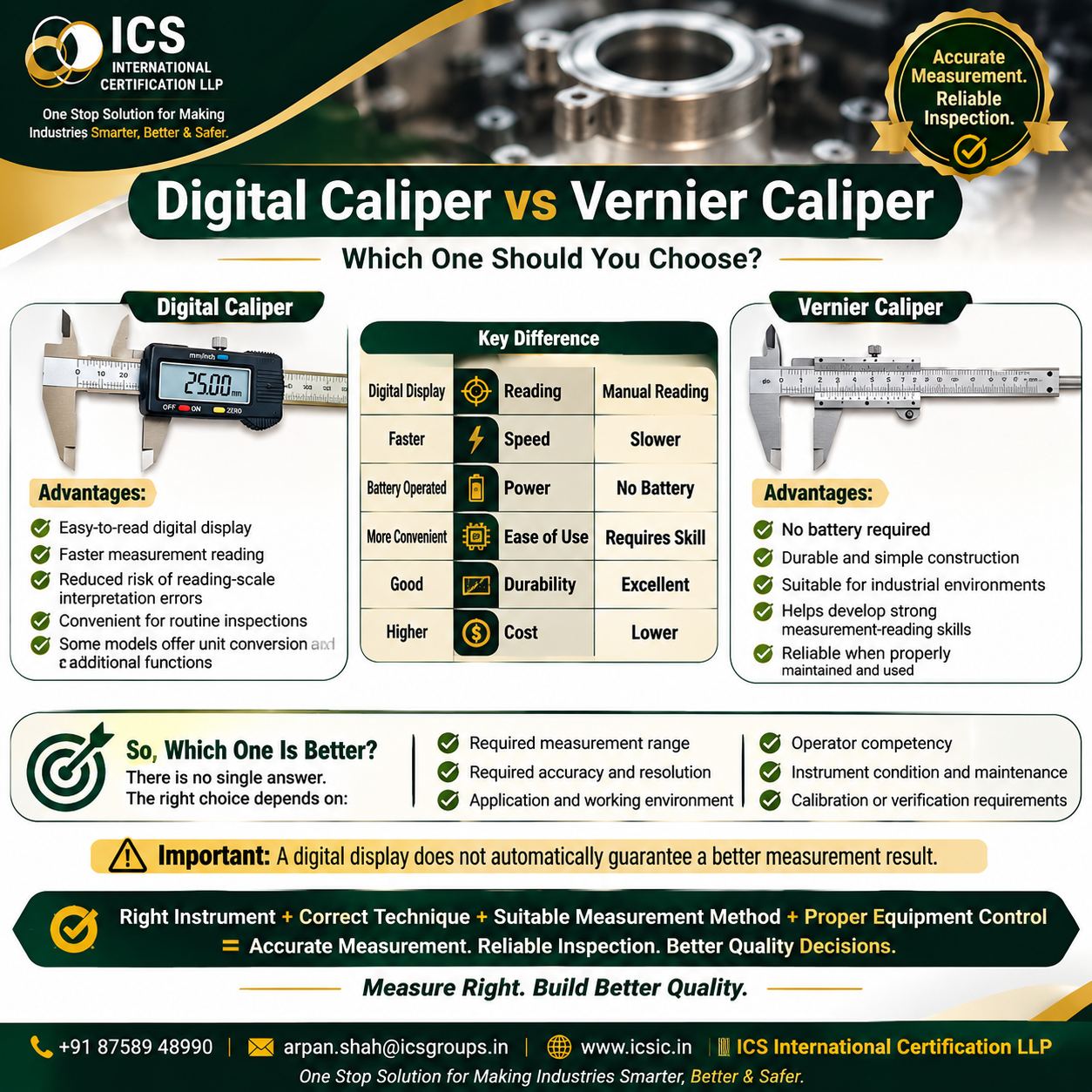
Advantages of a Digital Caliper
✅ Easy-to-read digital display
✅ Faster measurement reading
✅ Convenient for routine inspection
✅ Reduced risk of scale-reading interpretation errors
✅ Some models offer unit conversion and additional functions
✅ Suitable for users who need quick readings
Digital calipers are particularly popular where measurements need to be taken quickly and recorded efficiently.
What Is a Vernier Caliper?
A Vernier Caliper is a traditional measuring instrument that uses a main scale and a vernier scale.
The user determines the measurement by reading and interpreting the relationship between the two scales.
Vernier calipers can also be used for:
- Outside dimensions
- Inside dimensions
- Depth measurements
- Step measurements
Advantages of a Vernier Caliper
✅ No battery required
✅ Durable and simple construction
✅ Suitable for many industrial environments
✅ Less dependent on electronic components
✅ Helps develop measurement-reading skills
✅ Reliable when properly maintained and used
Because of their mechanical design, Vernier Calipers continue to be widely used in workshops, training environments, and industrial applications.
Digital Caliper vs Vernier Caliper: Key Differences
1. Reading Method
The most obvious difference is how the measurement is displayed.
Digital Caliper
The result is shown directly on an electronic display.
This can make reading faster and easier, especially during routine inspection.
Vernier Caliper
The measurement is determined manually by reading the main scale and vernier scale.
This requires greater familiarity with the instrument and proper reading technique.
2. Ease of Use
Digital Calipers are generally easier for beginners because the measurement is displayed directly.
With Vernier Calipers, the operator must understand how to read the scales correctly.
However, ease of reading should not be confused with measurement reliability.
Even a digital instrument can produce an unreliable result if it is:
- Used incorrectly
- Damaged
- Dirty
- Improperly zeroed
- Used outside its intended capability
- Not appropriately controlled
3. Speed of Measurement
For routine measurements, Digital Calipers can be faster because the operator does not need to manually interpret the scale.
This can be useful when inspecting multiple dimensions or components.
Vernier Calipers may take slightly longer because the reading must be interpreted manually.
However, with proper training and experience, skilled inspectors can read Vernier Calipers efficiently.
4. Power Requirement
This is one of the most significant practical differences.
Digital Caliper
A digital caliper requires electrical power, typically from a battery.
If the battery becomes weak or fails, the display may not function correctly.
Vernier Caliper
A traditional Vernier Caliper does not require a battery.
This can be an advantage in locations where electronic equipment may be inconvenient or where long-term mechanical simplicity is preferred.
5. Working Environment
The working environment should be considered when selecting an instrument.
Factors may include:
- Dust
- Coolant
- Moisture
- Temperature
- Oil
- Rough handling
- Frequency of use
The suitability of a specific instrument depends on its design, protection level, condition, and manufacturer’s specifications.
A digital caliper is not automatically unsuitable for industrial use, and a Vernier Caliper is not automatically suitable for every harsh environment.
The actual application must be considered.
6. Operator Skill
A Digital Caliper may reduce the effort required to read the measurement.
A Vernier Caliper requires the user to understand:
- Main scale reading
- Vernier scale reading
- Proper alignment
- Correct measurement technique
Learning to use a Vernier Caliper can help develop a stronger understanding of measurement principles.
However, regardless of the instrument, operator competency is essential.
7. Accuracy and Resolution
One of the most common misconceptions is:
“Digital Calipers are always more accurate than Vernier Calipers.”
This is not necessarily true.
The performance of a measuring instrument depends on factors such as:
- Instrument design
- Accuracy specification
- Resolution
- Calibration status
- Condition
- Measurement technique
- Environmental conditions
- Measurement range
A digital display showing more decimal places does not automatically mean the measurement is more accurate.
Important Principle:
Display resolution is not the same as measurement accuracy.
The selected instrument must be suitable for the required inspection decision.
How to Choose Between a Digital and Vernier Caliper
Before selecting a measuring instrument, consider the following factors.
1. Required Measurement Range
Ensure the instrument can measure the required component dimension.
Never attempt to use an instrument outside its specified range.
2. Required Accuracy and Resolution
Consider the tolerance of the component and the required measurement capability.
A general-purpose instrument may not always be suitable for tight-tolerance measurements.
Where measurement requirements are critical, factors such as measurement uncertainty and instrument capability may also need to be considered.
3. Application and Working Environment
Consider where and how the instrument will be used.
For example:
- Routine shop-floor inspection
- Incoming inspection
- Final inspection
- Training applications
- Laboratory measurements
- Harsh industrial environments
The instrument should be suitable for the actual working conditions.
4. Operator Competency
The person performing the measurement should understand:
- How to use the instrument
- How to position it correctly
- How to apply appropriate measuring force
- How to read or interpret the result
- How to identify obvious instrument problems
A measuring instrument is only as effective as the measurement process used with it.
5. Instrument Condition and Maintenance
Before use, inspect the instrument for possible issues such as:
- Damaged jaws
- Dirty measuring surfaces
- Loose movement
- Incorrect zero
- Damaged display
- Weak battery
- Physical damage
Regular care and appropriate storage can help maintain instrument performance.
6. Calibration or Verification Requirements
Organizations should control measuring equipment according to their applicable quality requirements.
Depending on the application, this may involve:
- Calibration
- Verification
- Functional checks
- Intermediate checks
- Identification and traceability
The objective is to maintain confidence that the measuring equipment is suitable for its intended use.
Common Mistakes When Using Calipers
Regardless of whether you use a Digital or Vernier Caliper, avoid these common mistakes:
❌ Measuring Dirty Components
Dust, burrs, chips, or oil can affect the measurement.
❌ Incorrect Alignment
The caliper must be positioned correctly relative to the dimension being measured.
❌ Excessive Measuring Force
Applying excessive force can affect the measurement, especially with softer or thinner components.
❌ Ignoring the Zero Reading
Check the zero condition before taking measurements.
❌ Using the Wrong Instrument
A caliper is versatile, but it may not be the most suitable instrument for every tolerance or geometry.
❌ Assuming Digital Means More Accurate
The measurement result depends on the entire measurement system—not only the display.
Which One Is Better for Component Inspection?
Both instruments have their advantages.
Choose a Digital Caliper when:
✔ Quick and easy reading is important
✔ Routine measurements are being performed
✔ Electronic display convenience is beneficial
✔ Fast dimensional checks are required
Choose a Vernier Caliper when:
✔ Battery-free operation is preferred
✔ A simple mechanical instrument is required
✔ The working environment favors mechanical simplicity
✔ Measurement-reading skills are important
The final decision should always depend on the actual inspection requirement.
The Role of Calibration in Reliable Measurement
Whether you use a Digital Caliper or a Vernier Caliper, equipment control is important.
A measuring instrument may require evaluation if it:
- Has been dropped
- Shows visible damage
- Produces inconsistent readings
- Does not return correctly to zero
- Has been repaired
- Has exceeded the established calibration or verification interval
Regular calibration or verification, where applicable, helps maintain confidence in measurement performance.
However, calibration alone is not enough.
A reliable measurement also depends on proper technique, suitable conditions, and correct instrument selection.
The Golden Rule of Measurement
A useful principle for dimensional inspection is:
Right Instrument + Correct Technique + Suitable Measurement Method + Proper Equipment Control = Reliable Measurement
The purpose of measurement is not simply to obtain a number.
The real objective is to obtain a result that is reliable enough to support the required quality decision.
Digital Caliper vs Vernier Caliper: Final Thoughts
Both Digital Calipers and Vernier Calipers remain valuable tools in manufacturing and quality inspection.
A Digital Caliper provides convenience, faster reading, and an easy-to-view electronic display.
A Vernier Caliper provides mechanical simplicity, battery-free operation, and develops traditional measurement-reading skills.
Neither instrument is automatically better in every situation.
The correct choice depends on:
📏 Measurement range
🎯 Required accuracy and resolution
⚙️ Application
🏭 Working environment
👨🔧 Operator competency
🔧 Instrument condition
📋 Calibration or verification requirements
Remember:
A digital display does not automatically guarantee a better measurement result.
Choose the instrument that is suitable for the application—and use it correctly.
Calibration and Inspection Support by ICS International Certification LLP
ICS International Certification LLP supports industries with services related to:
🔹 Calibration Services
🔹 Dimensional Inspection
🔹 Third-Party Inspection
🔹 Industrial Inspection
🔹 Machining Inspection
🔹 Casting Inspection
🔹 Fabrication Inspection
🔹 Forging Inspection
🔹 Quality and Compliance Support
Our objective is to help industries improve confidence in measurement, inspection, and quality processes.
📞 +91 87589 48990
📧 arpan.shah@icsgroups.in
🌐 www.icsic.in
ICS International Certification LLP
One Stop Solution for Making Industries Smarter, Better & Safer.