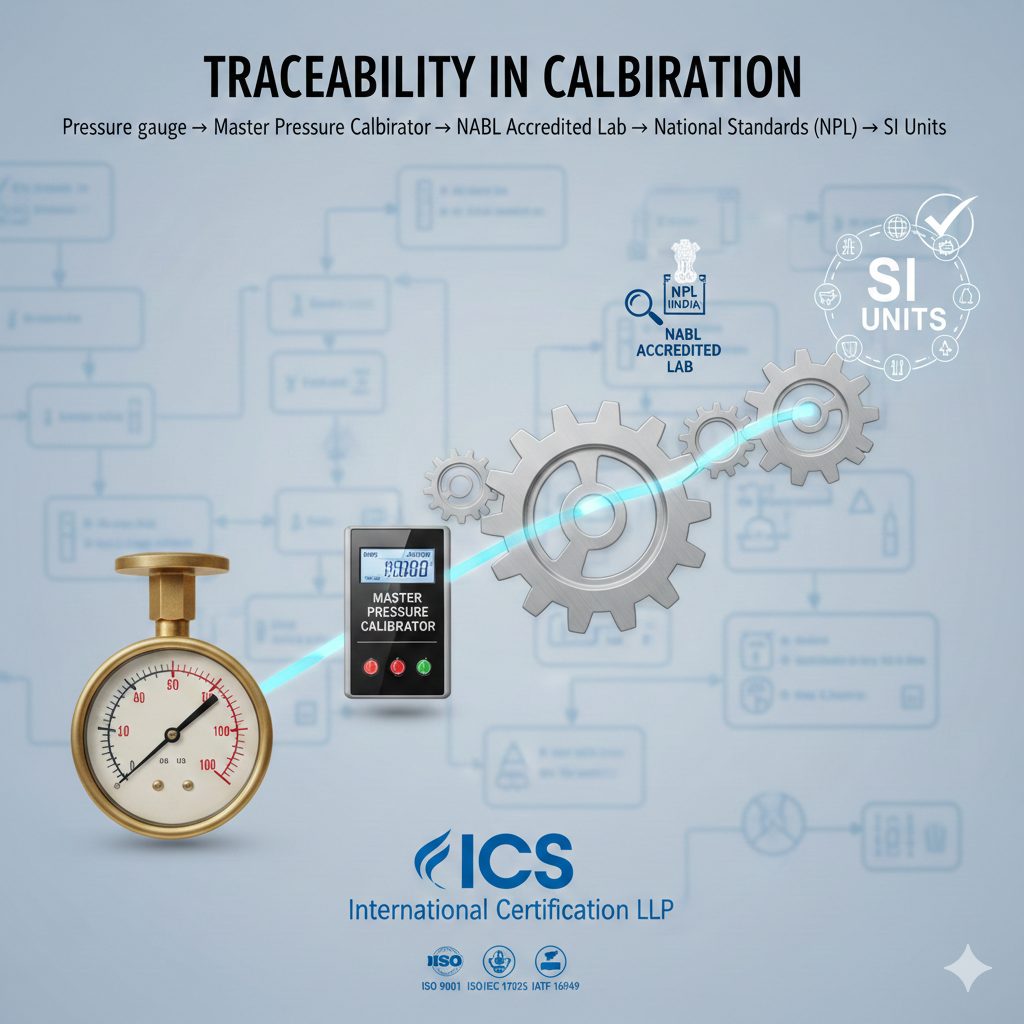
Traceability in calibration means the measurement of an instrument is linked to national or international standards through a continuous chain of comparisons with known uncertainty.

It confirms that the readings taken by an instrument are accurate and reliable, which is essential for ISO 9001, ISO/IEC 17025 and IATF 16949 compliance.

Example:
A pressure gauge is calibrated using a master pressure calibrator β†’ the master calibrator is calibrated by a NABL accredited lab β†’ the lab is linked to national standards (NPL) β†’ which are connected to SI units.
Hence, the pressure reading becomes traceable to international standards.

Without traceability, calibration has no validity because measurement accuracy cannot be proven.

ICS International Certification LLP helps organizations maintain proper calibration traceability as per international requirements.
Leave a Reply

Your email address will not be published. Required fields are marked *

Explore More

Why the Pharmaceutical Industry Needs Regular Calibration

In the pharmaceutical industry, precision is not optional. Every process, from raw material testing to final product release, relies on accurate measurements. Regular calibration of equipment ensures that these measurements

Understanding Calibration Labels and Tags

🏷️ Understanding Calibration Labels and Tags In any industry where measurement accuracy is critical, calibration plays a vital role in ensuring reliability and compliance. One of the simplest yet most

Impact of Measurement Uncertainty on Calibration Results

BY ICS INTERNATIONAL CERTIFICATION LLP 1. What is Measurement Uncertainty? Measurement uncertainty is the doubt associated with a measurement result. It represents a range: β€œThe true value is expected to