Pressure gauges are used to monitor operating pressure in machines, pipelines, boilers, and production systems. With time, vibration, temperature changes, and mechanical wear cause the gauge to lose accuracy. Calibration ensures the gauge shows the correct pressure and prevents accidents, product defects, and equipment damage.
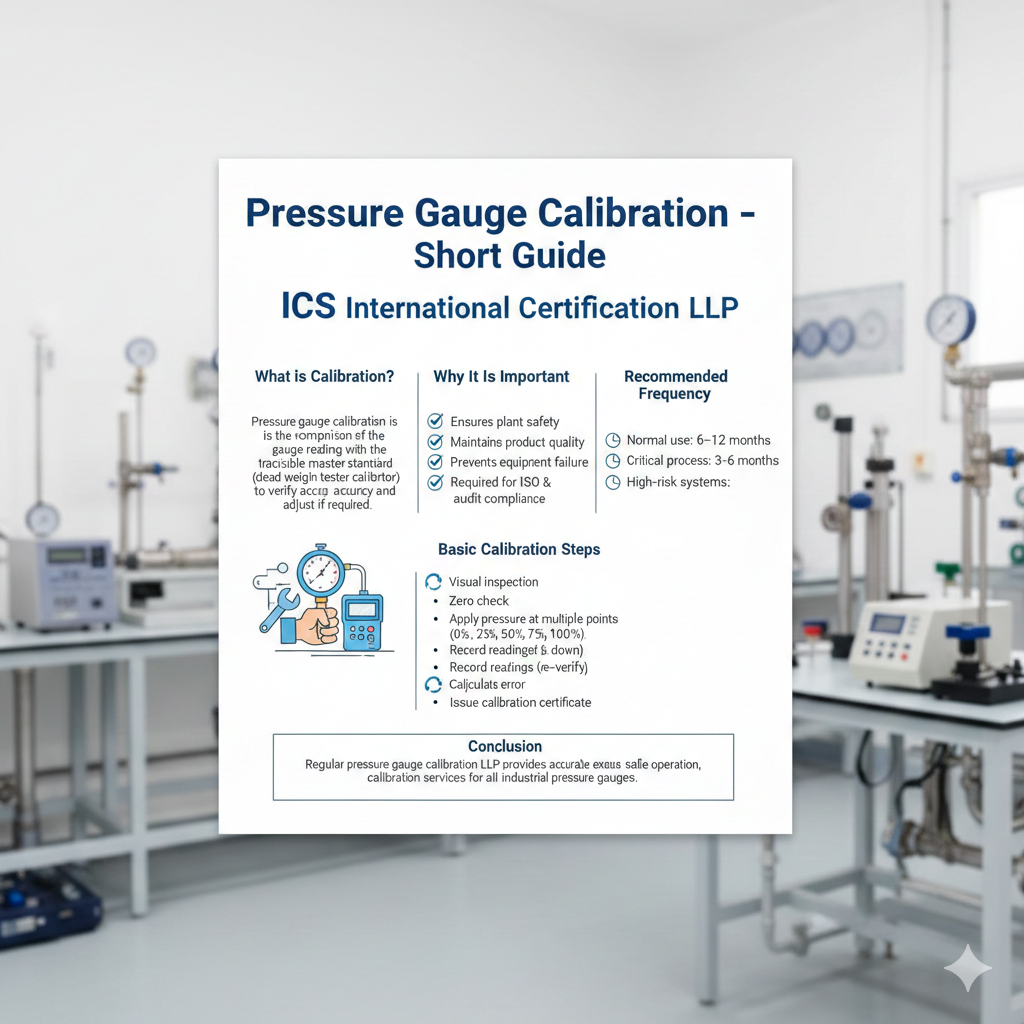
What is Calibration?
Pressure gauge calibration is the comparison of the gauge reading with a traceable master standard (dead weight tester or digital calibrator) to verify accuracy and adjust if required.
Why It Is Important
- Ensures plant safety
- Maintains product quality
- Prevents equipment failure
- Required for ISO & audit compliance
Basic Calibration Steps
- Visual inspection
- Zero check
- Apply pressure at multiple points (0%, 25%, 50%, 75%, 100%)
- Record readings (up & down)
- Calculate error
- Adjust and re-verify
- Issue calibration certificate
Recommended Frequency
- Normal use: 6–12 months
- Critical process: 3–6 months
- High-risk systems: 1–3 months
Conclusion
Regular pressure gauge calibration ensures safe operation, reliable readings, and compliance.
ICS International Certification LLP provides accurate and traceable calibration services for all industrial pressure gauges.