
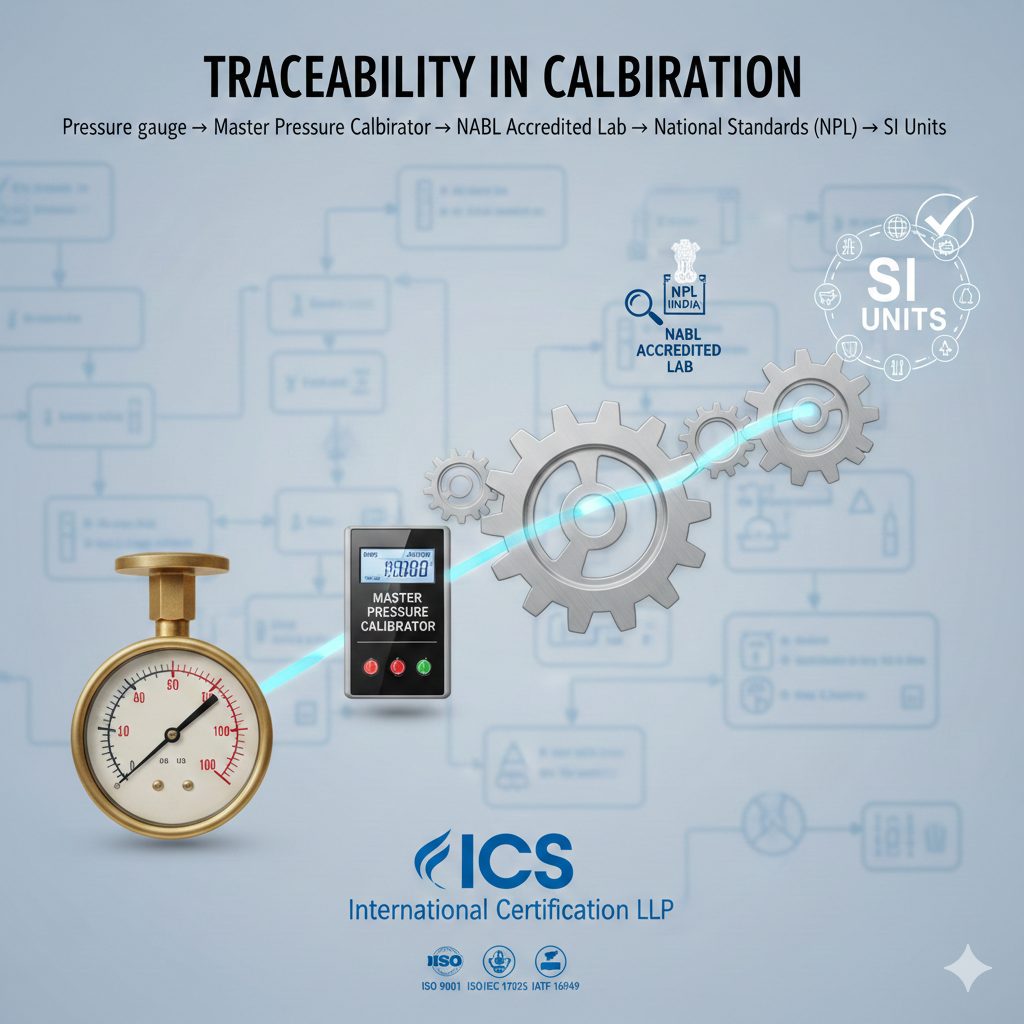
Traceability in calibration means the measurement of an instrument is linked to national or international standards through a continuous chain of comparisons with known uncertainty.

It confirms that the readings taken by an instrument are accurate and reliable, which is essential for ISO 9001, ISO/IEC 17025 and IATF 16949 compliance.

Example:
A pressure gauge is calibrated using a master pressure calibrator → the master calibrator is calibrated by a NABL accredited lab → the lab is linked to national standards (NPL) → which are connected to SI units.
Hence, the pressure reading becomes traceable to international standards.

Without traceability, calibration has no validity because measurement accuracy cannot be proven.

ICS International Certification LLP helps organizations maintain proper calibration traceability as per international requirements.

Leave a Reply

Your email address will not be published. Required fields are marked *

Explore More

What is Reference Standard in Calibration?

By ICS International Certification LLP A Reference Standard is a highly accurate and reliable measuring instrument or standard used as a benchmark for calibrating other instruments. It plays a critical

Calibration vs Verification – ICS International Certification LLP

Many industries confuse Calibration and Verification, but they serve different purposes in measurement control. Calibration is the process of comparing an instrument with a traceable standard to find its measurement

Understanding Measurement Error vs Measurement Uncertainty

In calibration, testing, and quality management systems such as ISO/IEC 17025, understanding the difference between measurement error and measurement uncertainty is essential. These two concepts are closely related but represent