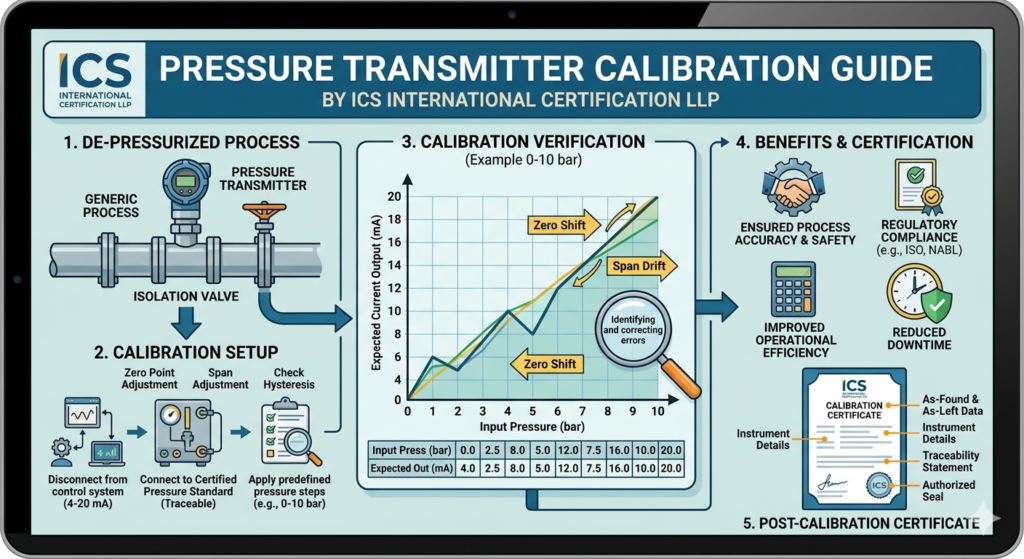
Calibration of Pressure Transmitters
By ICS International Certification LLP
In today’s precision-driven industries, accurate pressure measurement is essential for maintaining safety, efficiency, and product quality. At ICS International Certification LLP, we specialize in delivering reliable and traceable calibration services for pressure transmitters across a wide range of industries including oil & gas, pharmaceuticals, manufacturing, and power plants.
What is a Pressure Transmitter?
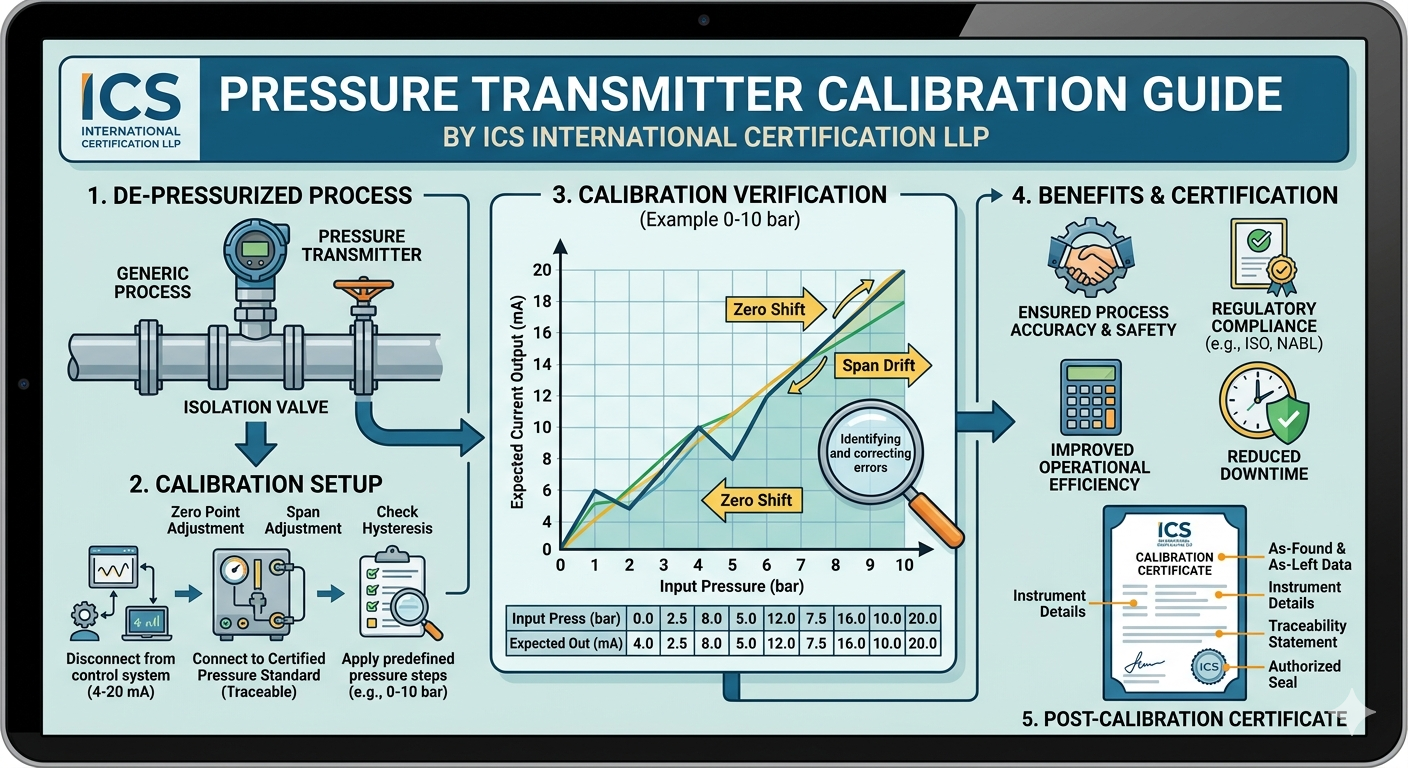
A pressure transmitter is an industrial instrument that measures the pressure of gases, liquids, or steam and converts it into a standardized electrical signal—typically 4–20 mA. This signal is then used by control systems to monitor and regulate processes in real time.
What is Calibration?
Calibration is the process of comparing the output of a pressure transmitter with a known reference standard. If any deviation is observed, the instrument is adjusted to ensure its readings are accurate and within acceptable limits.
Why is Calibration Important?
Regular calibration plays a critical role in:
- Ensuring accurate and reliable measurements
- Maintaining process safety and compliance
- Improving operational efficiency
- Reducing costly errors and downtime
- Meeting industry and regulatory standards such as ISO and NABL
Calibration Methods
Bench Calibration
Bench calibration is carried out in a controlled laboratory environment using high-precision instruments. It is ideal for critical applications where maximum accuracy is required.
Field Calibration
Field calibration is performed at the installation site without removing the transmitter. It minimizes downtime and is suitable for routine maintenance.
Types of Calibration
- Zero Calibration: Adjustment at 0% input pressure
- Span Calibration: Adjustment at full-scale pressure
- Multi-Point Calibration: Typically conducted at 0%, 25%, 50%, 75%, and 100% to ensure accuracy across the entire range
Standard Calibration Procedure
A typical calibration process followed by ICS International Certification LLP includes:
- Isolating the transmitter from the process
- Connecting a certified pressure source
- Applying pressure in predefined steps
- Measuring output signals (4–20 mA)
- Comparing actual readings with expected values
- Adjusting zero and span if required
- Re-verifying the instrument to ensure accuracy
Example Calibration (0–10 bar Range)
| Input Pressure | Expected Output |
|---|---|
| 0 bar | 4 mA |
| 2.5 bar | 8 mA |
| 5 bar | 12 mA |
| 7.5 bar | 16 mA |
| 10 bar | 20 mA |
Common Errors Identified During Calibration
- Zero shift
- Span drift
- Non-linearity
- Hysteresis
Identifying and correcting these issues ensures optimal instrument performance.
Calibration Certification
After calibration, ICS International Certification LLP provides a detailed certificate that includes:
- As-found and as-left readings
- Instrument details and identification
- Calibration date and next due date
- Traceability to national/international standards
- Authorized approval and documentation
Why Choose ICS International Certification LLP?
- Accurate and traceable calibration services
- Experienced and skilled professionals
- Quick turnaround time
- Compliance with global standards
- Customer-focused service approach
Conclusion
Calibration of pressure transmitters is not just a maintenance activity—it is a critical requirement for ensuring process accuracy, safety, and compliance. With expert services from ICS International Certification LLP, businesses can operate with confidence, knowing their instruments deliver precise and reliable results.
For professional calibration services, get in touch with ICS International Certification LLP today and ensure your instruments meet the highest standards of accuracy and performance.