By ICS International Certification LLP
Flow meter calibration is a critical process to ensure that flow measurement instruments provide accurate, reliable, and traceable results. At ICS International Certification LLP, we follow internationally accepted practices to deliver precise calibration services across various industries including oil & gas, pharmaceuticals, water treatment, and manufacturing.
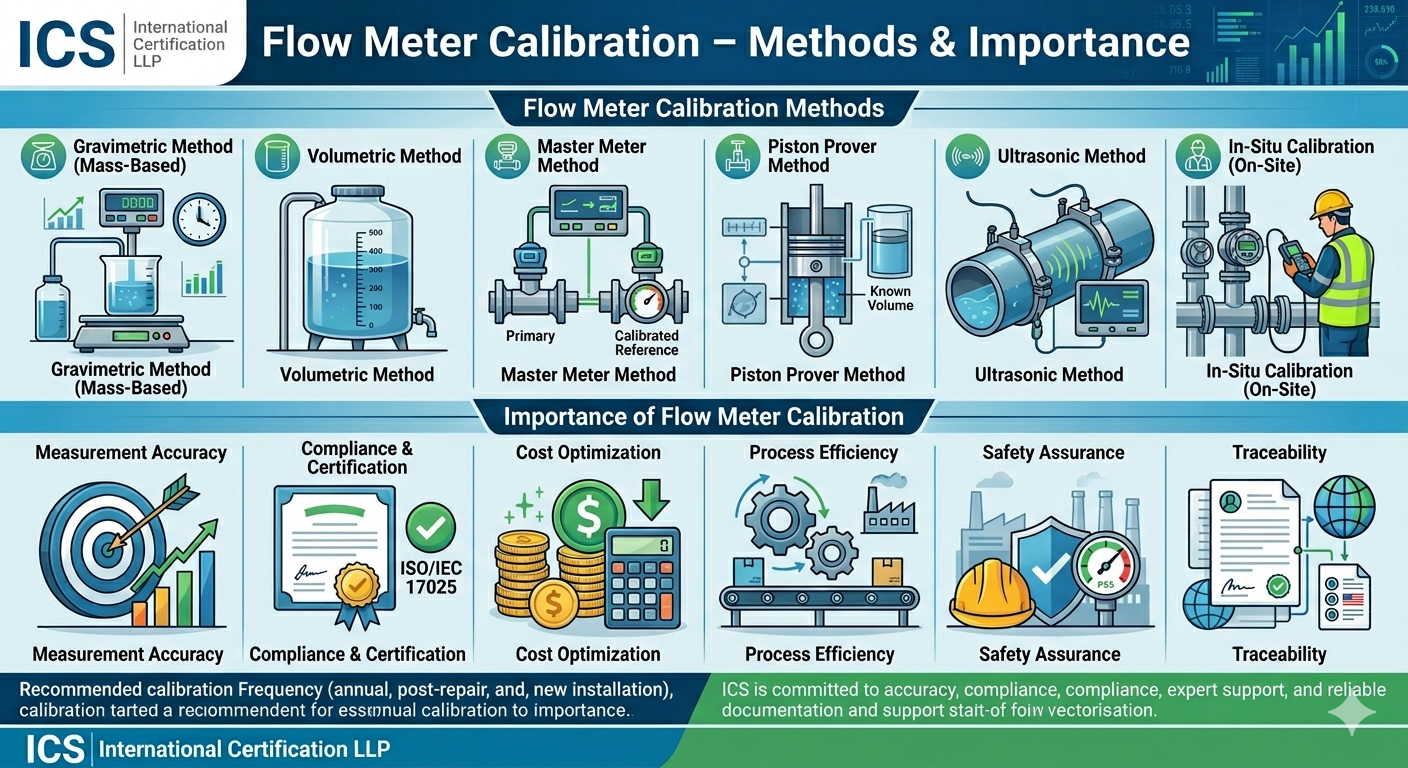
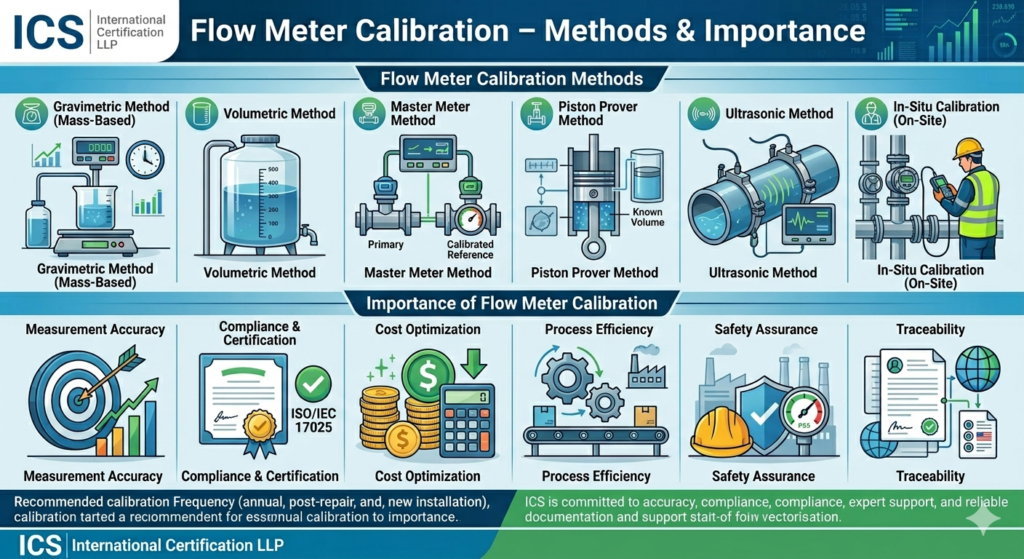
Flow Meter Calibration Methods
1. Gravimetric Method (Mass-Based Calibration)
This method determines flow by measuring the mass of fluid collected over time.
- Considered the most accurate primary standard
- Suitable for high-precision laboratory calibration
- Traceable to national/international standards
2. Volumetric Method
Flow is calculated by collecting fluid in a calibrated volume tank.
- Simple and widely used
- Cost-effective for industrial applications
- Slightly lower accuracy compared to gravimetric method
3. Master Meter Method
A calibrated reference meter is used to compare readings.
- Ideal for on-site calibration
- Fast and efficient
- Accuracy depends on the master meter’s calibration
4. Piston Prover Method
A known volume is displaced using a piston mechanism.
- Highly precise and repeatable
- Commonly used in fuel and custody transfer systems
5. Ultrasonic Method
Non-intrusive technique using ultrasonic signals.
- Suitable for large pipelines
- No interruption to process flow
- Useful for verification and diagnostics
6. In-Situ Calibration (On-Site)
Calibration performed without removing the flow meter.
- Minimizes downtime
- Convenient for continuous processes
- Requires controlled conditions for best accuracy
⚙️ Importance of Flow Meter Calibration
1. Measurement Accuracy
Ensures reliable and precise flow readings, reducing operational errors.
2. Compliance & Certification
Supports compliance with international standards such as ISO/IEC 17025, ensuring audit readiness.
3. Cost Optimization
Prevents material losses due to incorrect flow measurement, especially in high-value fluids.
4. Process Efficiency
Maintains optimal system performance and improves product consistency.
5. Safety Assurance
Accurate flow measurement helps prevent hazardous situations in critical applications.
6. Traceability
Provides documented evidence linking measurements to recognized standards.
🧪 Recommended Calibration Frequency
At ICS International Certification LLP, we recommend calibration:
- At defined periodic intervals (quarterly/annually)
- After repair or maintenance
- Upon installation of new equipment
- When measurement deviations are observed
Our Commitment
ICS International Certification LLP is dedicated to delivering:
- Accurate and traceable calibration services
- Compliance with international standards
- Expert technical support
- Reliable documentation and certification