BY ICS INTERNATIONAL CERTIFICATION LLP
1. What is Pressure Transmitter Calibration?
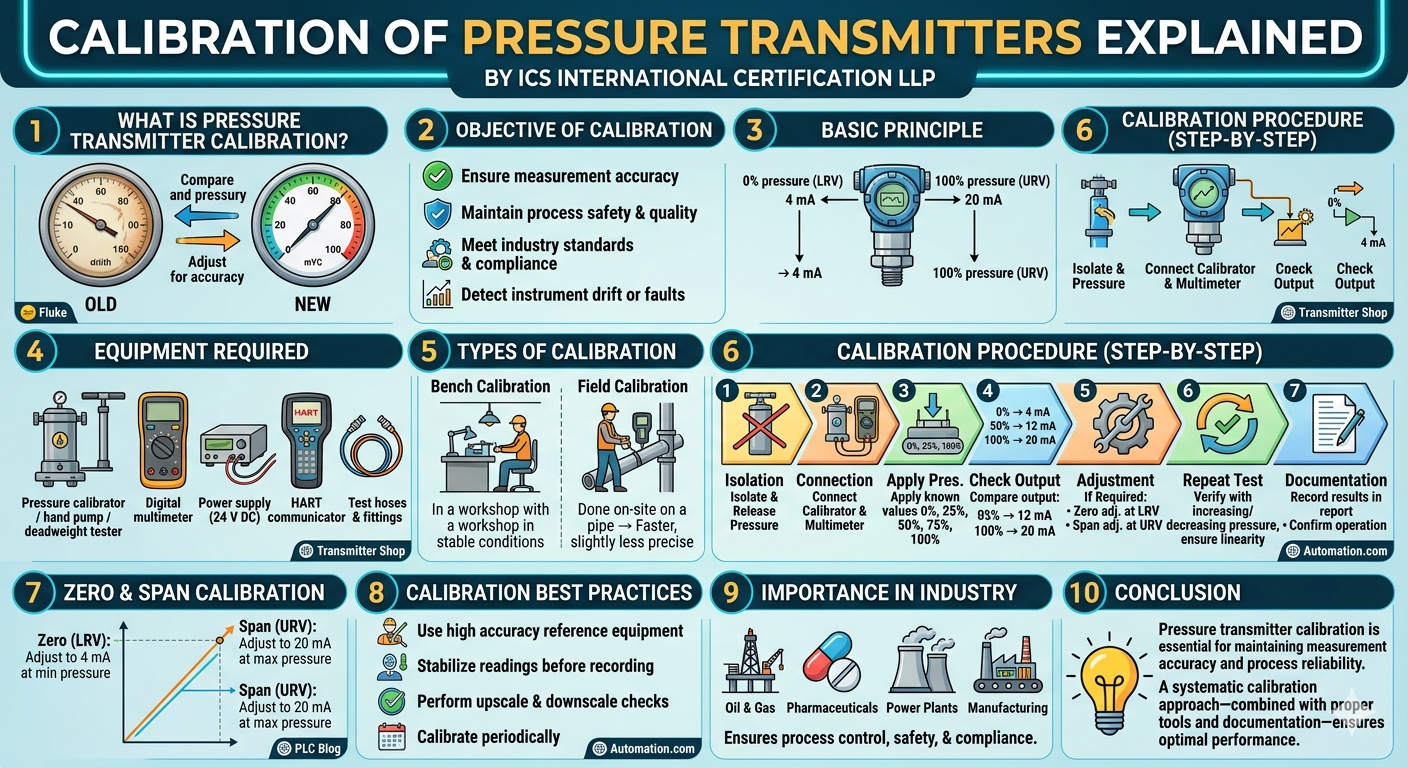
Pressure transmitter calibration is the process of comparing and adjusting a transmitter’s output (usually 4–20 mA) with a known, accurate pressure reference to ensure precise measurement.
Over time, transmitters may drift due to environmental conditions, wear, or process stress, leading to inaccurate readings. Calibration restores accuracy and reliability.
2. Objective of Calibration
- Ensure measurement accuracy
- Maintain process safety and quality
- Meet industry standards and compliance
- Detect instrument drift or faults
3. Basic Principle
A pressure transmitter converts applied pressure into an electrical signal:
- 0% pressure (LRV) → 4 mA
- 100% pressure (URV) → 20 mA
Calibration ensures this relationship is accurate across the entire range. (Transmitter Shop)
4. Equipment Required
- Pressure calibrator / hand pump / deadweight tester
- Digital multimeter or loop calibrator
- Power supply (typically 24 V DC)
- HART communicator (for smart transmitters)
- Test hoses and fittings (Transmitter Shop)
5. Types of Calibration
a) Bench Calibration
- Performed in workshop conditions
- Higher accuracy due to controlled environment
b) Field Calibration
- Done at site without removing transmitter
- Faster but slightly less precise
6. Calibration Procedure (Step-by-Step)
Step 1: Isolation
- Isolate the transmitter from the process
- Release pressure safely
Step 2: Connection
- Connect pressure calibrator to transmitter
- Connect multimeter in loop to measure mA
Step 3: Apply Pressure
- Apply known pressure values (0%, 25%, 50%, 75%, 100%)
- Record output signal
Step 4: Check Output
- Compare measured output with expected values:
- 0% → 4 mA
- 50% → 12 mA
- 100% → 20 mA (Automation.com)
Step 5: Adjustment (If Required)
- Perform:
- Zero adjustment at LRV
- Span adjustment at URV
Step 6: Repeat Test
- Verify readings by increasing and decreasing pressure
- Ensure linearity and repeatability
Step 7: Documentation
- Record results in calibration report
- Confirm proper operation in system
7. Zero & Span Calibration
- Zero (LRV): Adjust output to 4 mA at minimum pressure
- Span (URV): Adjust output to 20 mA at maximum pressure
8. Calibration Best Practices
- Use reference equipment with higher accuracy
- Stabilize readings before recording
- Perform both upscale and downscale checks
- Calibrate periodically (based on application conditions
9. Importance in Industry
Calibration is critical in industries like:
- Oil & Gas
- Pharmaceuticals
- Power Plants
- Manufacturing
It ensures process control, safety, and regulatory compliance.
10. Conclusion
Pressure transmitter calibration is essential for maintaining measurement accuracy and process reliability. A systematic calibration approach—combined with proper tools and documentation—ensures optimal performance of instrumentation systems.