BY ICS INTERNATIONAL CERTIFICATION LLP
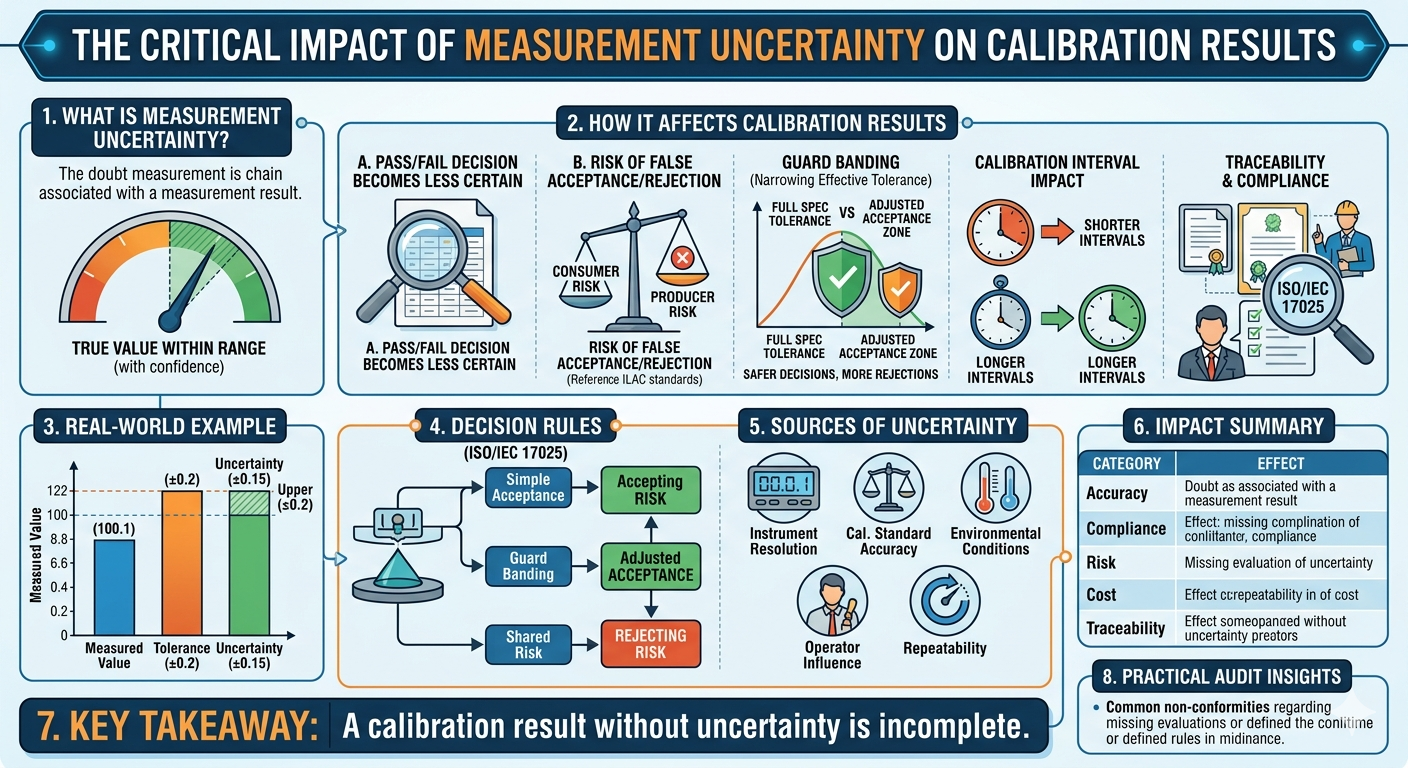
1. What is Measurement Uncertainty?
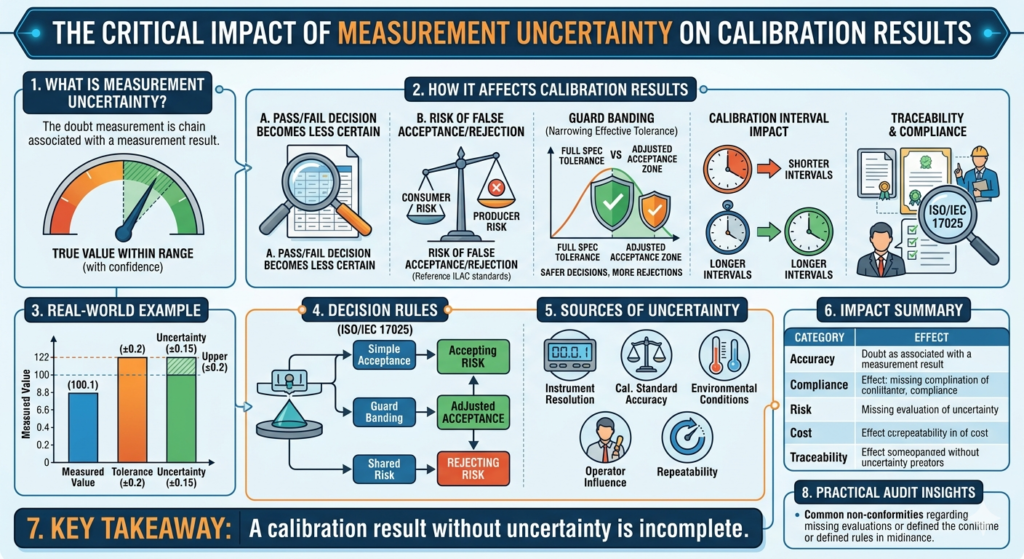
Measurement uncertainty is the doubt associated with a measurement result.
It represents a range:
“The true value is expected to lie within this range with a stated level of confidence.”
2. How It Affects Calibration Results
A. Pass / Fail Decision Becomes Less Certain
Without uncertainty:
- Measured value = 10.02
- Tolerance = ±0.05 → PASS ✅
With uncertainty:
- Result = 10.02 ± 0.04
➡ True value could be 10.06 (out of tolerance) ❗
👉 This creates decision risk
B. Risk of False Acceptance / Rejection
Two key risks:
- False Acceptance (Consumer Risk)
Accepting a bad instrument - False Rejection (Producer Risk)
Rejecting a good instrument
Standards from ILAC emphasize controlling these risks.
C. Narrowing of Effective Tolerance (Guard Banding)
To reduce risk, labs apply guard bands:
- Spec limit: ±1.0
- Adjusted acceptance: ±0.8
➡ Uncertainty is “absorbed” inside tolerance
Impact:
- Safer decisions
- But more rejections
D. Impact on Calibration Interval
Higher uncertainty:
- Reduces confidence in results
- May require shorter calibration intervals
Lower uncertainty:
- Enables longer intervals with confidence
E. Traceability & Compliance
Uncertainty must be:
- Calculated
- Reported
- Justified
As required by ISO standards.
Failure to account for uncertainty can:
- Invalidate calibration certificates
- Lead to audit non-conformities
3. Real-World Example
| Parameter | Value |
|---|---|
| Measured Value | 100.1 |
| Tolerance | ±0.2 |
| Uncertainty | ±0.15 |
➡ Range = 99.95 to 100.25
👉 Upper limit exceeds tolerance → Decision becomes uncertain
4. Decision Rules (Very Important)
Under ISO/IEC 17025:
Labs must define decision rules, such as:
- Simple acceptance (ignore uncertainty)
- Guard banding
- Shared risk method
5. Sources of Measurement Uncertainty
- Instrument resolution
- Calibration standard accuracy
- Environmental conditions (temperature, humidity)
- Operator influence
- Repeatability
6. Impact Summary
| Aspect | Impact |
|---|---|
| Accuracy | Defines confidence in result |
| Compliance | Mandatory for ISO audits |
| Risk | Controls false decisions |
| Cost | Influences recalibration & rejection |
| Traceability | Ensures reliability of measurements |
7. Key Takeaway
A calibration result without uncertainty is incomplete.
It’s not just “what is measured” —
it’s how sure you are about it that matters.
8. ICS Practical Insight
In real audits and certification work:
- Most non-conformities occur due to:
- Missing uncertainty evaluation
- No defined decision rule
- Incorrect guard banding